Sanakirja
Tekoälykääntäjä


Vaihtoehtoiset kirjoitusmuodot
- (vanhentunut) storme
Synonyymit

Määritelmät
Substantiivi
- Any disturbed state of the atmosphere causing destructive or unpleasant weather, especially one affecting the earth's surface involving strong winds (leading to high waves at sea) and usually lightning, thunder, and precipitation.
- (military) A violent assault on a fortified position or stronghold.
- (by extension) A heavy fall of precipitation (hail, rain, or snow) or bout of lightning and thunder without strong winds; a hail storm, rainstorm, snowstorm, or thunderstorm.
- (by extension) Synonym of cyclone (“a weather phenomenon consisting of a system of winds rotating around a centre of low atmospheric pressure”).
- (by extension, Canada, Scotland, US, dated) A period of frosty and/or snowy weather.
- (meteorology) A disturbed state of the atmosphere between a severe or strong gale and a hurricane on the modern Beaufort scale, with a wind speed of between 89 and 102 kilometres per hour (55–63 miles per hour; 10 on the scale, known as a "storm" or whole gale), or of between 103 and 117 kilometres per hour (64–72 miles per hour; 11 on the scale, known as a "violent storm").
- A heavy expulsion or fall of things (as blows, objects which are thrown, etc.).
- A violent agitation of human society; a domestic, civil, or political commotion.
- A violent commotion or outbreak of sounds, speech, thoughts, etc.; also, an outpouring of emotion.
- (pathology) Chiefly with a qualifying word: a violent attack of diease, pain, physiological reactions, symptoms, etc.; a paroxysm.
- (Canada, US, chiefly in the plural) Ellipsis of storm window (“a second window (originally detachable) attached on the exterior side of a window in climates with harsh winters, to add an insulating layer of still air between the outside and inside”).
Verbi
- (impersonal, chiefly US) Preceded by the dummy subject it: to have strong winds and usually lightning and thunder, and/or hail, rain, or snow.
- To make (someone or something) stormy; to agitate (someone or something) violently.
- To disturb or trouble (someone).
- To use (harsh language).
- (chiefly military) To violently assault (a fortified position or stronghold, a building, etc.) with the aim of gaining control of it.
- (figurative, often poetic) To assault or gain control or power over (someone's heart, mind, etc.).
- (by extension, especially in command economies) To catch up (on production output) by making frenzied or herculean efforts.
- (British, dialectal, agriculture) To protect (seed-hay) from stormy weather by putting sheaves of them into small stacks.
- Of the weather: to be violent, with strong winds and usually lightning and thunder, and/or hail, rain, or snow.
- To be exposed to harsh (especially cold) weather.
- To move noisily and quickly like a storm (noun ), usually in a state of anger or uproar.
- (by extension, chiefly military) To move quickly in the course of an assault on a fortified position or stronghold, a building, etc.
- To be in a violent temper; to use harsh language; to fume, to rage.
Esimerkit
- We hear this fearful tempest sing, / Yet seek no shelter to avoid the storm.
- Phoenix and Lubbock are both caught in severe drought, and it is going to get much worse. We may see many such [dust] storms in the decades ahead, along with species extinctions, radical disturbance of ecosystems, and intensified social conflict over land and water. Welcome to the Anthropocene, the epoch when humans have become a major geological and climatic force.
- The proposed reforms have led to a political storm.
- Her sister / Began to scold and raise up such a storm.
- She stormed out of the room.
- Troops stormed the complex.
Taivutusmuodot
| Partisiipin perfekti | stormed | Imperfekti | stormed |
| Partisiipin preesens | storming | Monikko | storms |
| Yksikön kolmannen persoonan indikatiivin preesens | storms | Yksikön kolmannen persoonan indikatiivin preesens | stormeth (vanhahtava) |
Luokat
Any disturbed state of the atmosphere causing destructive or unpleasant weather, especially one affecting the earth's surface involving strong winds (leading to high waves at sea) and usually lightning, thunder, and precipitation.
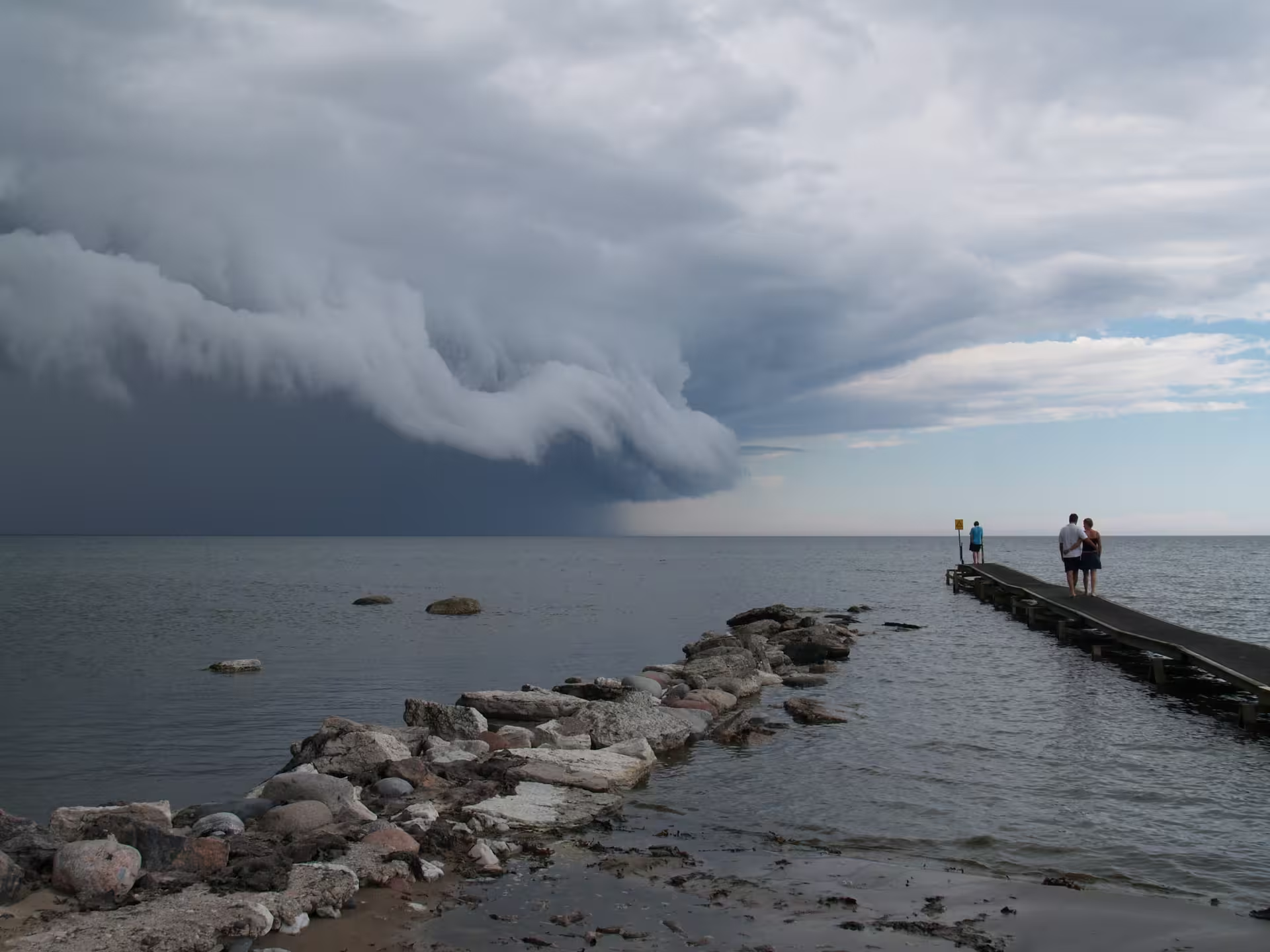
A storm seen at the Baltic Sea near the island of Öland, Sweden.
(by extension) A heavy fall of precipitation (hail, rain, or snow) or bout of lightning and thunder without strong winds; a hail storm, rainstorm, snowstorm, or thunderstorm.

Classic summer thunderstorm with lightning in Sierras de Córdoba, Argentina.
(by extension) Synonym of cyclone (“a weather phenomenon consisting of a system of winds rotating around a centre of low atmospheric pressure”).

Typhoon Haiyan, a massive tropical cyclone that struck the Philippines in late 2013.
