Sanakirja
Tekoälykääntäjä


Synonyymit

Määritelmät
Verbi
- To conclude or resolve (something):
- (transitive) To determine (something which was exposed to doubt or question); to resolve conclusively; to set or fix (a time, an order of succession, etc).
- (transitive) To conclude, to cause (a dispute) to finish.
- (transitive) In particular, to terminate (a lawsuit), usually out of court, by agreement of all parties.
- (transitive) To close, liquidate or balance (an account) by payment, sometimes of less than is owed or due.
- (transitive, colloquial) To pay (a bill).
- (intransitive) To adjust differences or accounts; to come to an agreement on matters in dispute.
- (intransitive) To conclude a lawsuit by agreement of the parties rather than a decision of a court.
- (transitive) To place or arrange in(to) a desired (especially: calm) state, or make final disposition of (something).
- (transitive) To put into (proper) place; to make sit or lie properly.
- (transitive) To cause to no longer be in a disturbed, confused or stormy; to quiet; to calm (nerves, waters, a boisterous or rebellious child, etc).
- (British, dialectal) To silence, especially by force.
- To kill.
- (transitive) To bring or restore (ground, roads, etc) to a smooth, dry, or passable condition.
- (intransitive) To become calm, quiet, or orderly; to stop being agitated.
- (intransitive) To become firm, dry, and hard, like the ground after the effects of rain or frost have disappeared.
- To establish or become established in a steady position:
- (transitive) To place in(to) a fixed or permanent condition or position or on(to) a permanent basis; to make firm, steady, or stable; to establish or fix.
- (transitive) In particular, to establish in life; to fix in business, in a home, etc.
- (transitive, US, obsolete) In particular, to establish in pastoral office; to ordain or install as pastor or rector of a church, society, or parish.
- (transitive, law) To formally, legally secure (an annuity, property, title, etc) on (a person).
- (intransitive, obsolete) To make a jointure for a spouse.
- (intransitive) To become married, or a householder.
- (intransitive, with "in") To be established in a profession or in employment.
- (intransitive, usually with "down", "in", "on" or another preposition) To become stationary or fixed; to come to rest.
- (intransitive) To fix one's residence in a place; to establish a dwelling place, home, or colony. (Compare settle down.)
- (transitive, in particular) To colonize (an area); to migrate to (a land, territory, site, etc).
- (transitive) To move (people) to (a land or territory), so as to colonize it; to cause (people) to take residence in (a place).
- To sink, or cause (something, or impurities within it) to sink down, especially so as to become clear or compact.
- (transitive) To clear or purify (a liquid) of dregs and impurities by causing them to sink.
- (transitive) To cause to sink down or to be deposited (dregs, sediment, etc).
- (transitive) To render compact or solid; to cause to become packed down.
- (intransitive) To sink to the bottom of a body of liquid, as dregs of a liquid, or the sediment of a reservoir.
- (intransitive) To sink gradually to a lower level; to subside, for example the foundation of a house, etc.
- (intransitive) To become compact due to sinking.
- (intransitive) To become clear due to the sinking of sediment. (Used especially of liquid. Also used figuratively.)
- (ambitransitive) Of an animal: to make or become pregnant.
Substantiivi
- (archaic) A seat of any kind.
- (now rare) A long bench with a high back and arms, often with chest or storage space underneath.
- (obsolete) A place made lower than the rest; a wide step or platform lower than some other part. (Compare a depression.)
Esimerkit
- And he settled his countenance steadfastly upon him,until he was ashamed. --2 Kings VIII. 11. (Rev. Ver.)
- The father thought the time drew on Of settling in the world his only son.
- to settle a minister
- God settled then the huge whale-bearing lake.
- Hoping that sleep might settle his brains.
- to settle coffee, or the grounds of coffee
- clear weather settles the roads
- to settle the contents of a barrel or bag by shaking it
- It will settle the wavering, and confirm the doubtful.
- to settle the mind when agitated; to settle questions of law; to settle the succession to a throne; to settle an allowance
- to settle a quarrel
- to settle an account
- to settle a bill
- the French first settled Canada; the Puritans settled New England; Plymouth was settled in 1620.
- The wind came about and settled in the west.
- Chyle[...]runs through all the intermediate colors until it settles in an intense red.
- the Saxons who settled in Britain
- As people marry now and settle.
- to settle in the practice of law
- the roads settled late in the spring.
- A government, on such occasions, is always thick before it settles.
- the weather settled; wine settles by standing
- Till the fury of his highness settle, Come not before him.
- He has settled with his creditors.
- He sighs with most success that settles well.
- upon the settle of his majesty
- And from the bottom upon the ground, even to the lower settle, shall be two cubits, and the breadth one cubit.
- settle one's affairs
- 'You'll have to settle your debts before you can truly call yourself a free person.
- The French colonists settled in Quebec and Acadia (now New Brunswick and Nova Scotia).
- The American Indians settled North and South America.
- ~ a dispute
- ~ a case
- dust settled
- Why settle for an apartment when you could own a house?
Taivutusmuodot
| Partisiipin perfekti | settled |
| Imperfekti | settled |
| Partisiipin preesens | settling |
| Monikko | settles |
| Yksikön kolmannen persoonan indikatiivin preesens | settles |
Luokat
(now rare) A long bench with a high back and arms, often with chest or storage space underneath.

A settle
(now rare) A long bench with a high back and arms, often with chest or storage space underneath.

Seventeenth-century oak settle Dimensions: length 70 inches (180 cm), height 41.5 inches (105 cm), depth 23 inches (58 cm).
(now rare) A long bench with a high back and arms, often with chest or storage space underneath.
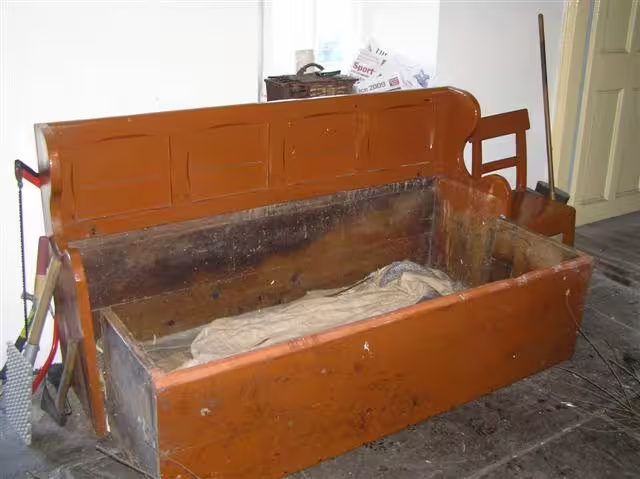
Irish settle bed, folded out for use as a bed