Sanakirja
Tekoälykääntäjä

Kuvat
11

Synonyymit
- (soitin)musical saw
- saying
- proverb

| Kieli | Käännökset |
|---|---|
| bulgaria | трио́н |
| espanja | proverbio, dicho, sierra, serrar, refrán |
| esperanto | segi, segilo |
| hollanti | spreekwoord, gezegde, zaag, zagen, spreuk |
| italia | sega, segare, adagio, modo di dire |
| japani | 切る (kiru), 鋸 (nokogiri), 挽く (hiku), のこぎり (nokogiri), みた (mita), 見た (mita) |
| kreikka | απόφθεγμα (apófthegma / apóftheɣma), πριόνι (prióni), ρήση (rísi), πριονίζω (prionízo / prionizo) |
| latina | serra, serrare, prōverbium, lāmina |
| latvia | zāģis, zāģēt |
| liettua | pjūklas |
| norja | sage |
| portugali | provérbio, serra, serrar, serrote |
| puola | piła, piłować, rżnąć, piłka |
| ranska | proverbe, scie, scier |
| ruotsi | såg, såga, ordstäv |
| saksa | Sprichwort, Säge, sägen, Spruch |
| suomi | sahata, saha |
| tanska | sav |
| turkki | testere |
| tšekki | pila, řezat |
| unkari | fűrész, fűrészel |
| venäjä | пословица (poslovitsa), пилить (pilit), поговорка (pogovorka), пила́ (pilá), пила (pila), лесопильный (lesopilnyi) |
| viro | saag |
Määritelmät
Substantiivi
- A tool with a toothed blade used for cutting hard substances, in particular wood or metal.
- (obsolete) Something spoken; speech, discourse.
- Such a tool with an abrasive coating instead of teeth.
- (archaic) A saying or proverb.
- A musical saw.
- (obsolete) Opinion, idea, belief.
- A sawtooth wave.
- (obsolete) Proposal, suggestion; possibility.
- (whist) The situation where two partners agree to trump a suit alternately, playing that suit to each other for the express purpose.
- (obsolete) Dictate; command; decree.
Verbi
Esimerkit
- They were stoned, they were sawn asunder, were tempted, were slain with the sword: they wandered about in sheepskins and goatskins; being destitute, afflicted, tormented;
- The fiddler sawed away at his instrument.
- The timber saws smoothly.
- to saw boards or planks (i.e. to saw logs or timber into boards or planks)
- to saw shingles; to saw out a panel
- And for thy trew sawys, and I may lyve many wynters, there was never no knyght better rewardid.
- All they assentyd to the sawe; They thoght he spake reson and lawe.
- Þe more comoun sawe is þat Remus was i-slawe for he leep ouer þe newe walles of Rome.
- [Love] rules the creatures by his powerful saw.
- He used a saw to cut the wood.
- Can you saw the table please?
- He saw Romeo.
Taivutusmuodot
| Partisiipin perfekti | sawed | Partisiipin perfekti | sawn |
| Imperfekti | sawed | Partisiipin preesens | sawing |
| Monikko | saws | Yksikön kolmannen persoonan indikatiivin preesens | saws |
| Yksikön kolmannen persoonan indikatiivin preesens | saweth (vanhahtava) |
Luokat
A tool with a toothed blade used for cutting hard substances, in particular wood or metal.

Rip saws of various sizes
A tool with a toothed blade used for cutting hard substances, in particular wood or metal.
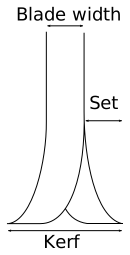
Diagram showing the teeth of a saw blade when looking front-on. The teeth protrude to the left and right, so that the saw cut (kerf) is wider than the blade width. (The term set describes how much the teeth protrude. The kerf may sometimes be wider than the set, depending on wobble and other factors.
