Sanakirja
Tekoälykääntäjä


Synonyymit
- copper
- pig
- pigs
- cop
- bobby
- bobbies
- filth
- the cobblers
- the fuzz
- popo
- the heat
- peelers
- (brittienglanti)woodentops
- woodentop
- the law
- police force
- police department
- police service
- (rikoslaki)police authority
Ääntäminen

Lyhenteet
- (politiikka) POP
Määritelmät
Substantiivi
- (law enforcement) A public agency charged with enforcing laws and maintaining public order, usually being granted special privileges to do so, particularly
- (Canada, US, and historical) A department of local (usually municipal) government responsible for general law enforcement.
- (UK) A branch of the Home Office responsible for general law enforcement within a specific territory.
- (Australia, New Zealand) Any of the formally enacted law enforcement agencies at various levels of government.
- (usually plural only) The staff of such a department or agency, particularly its officers; (regional, chiefly US, Caribbean, Jamaica, Scotland, countable) an individual police officer.
- (figuratively, usually ironic and mildly derogatory) People who try to enforce norms or standards as if granted authority similar to the police.
- (military, slang) Cleanup of a military facility, as a formal duty.
- (archaic, now rare) Synonym of administration, the regulation of a community or society.
- (obsolete) Alternative form of policy.
- (obsolete) Alternative form of polity, civilization, a regulated community.
Verbi
- (transitive) To enforce the law and keep order among (a group).
- (ambitransitive, military, slang) To clean up an area.
- (transitive, figurative) To enforce norms or standards upon.
Esimerkit
- ‘Then the father has a great fight with his terrible conscience,’ said Munday with granite seriousness. ‘Should he make a row with the police […]? Or should he say nothing about it and condone brutality for fear of appearing in the newspapers?
- Call the police!
- The police operating in New York City operate under the New York City Police Department, several other City agencies and boards, and several public authorities.
- This time it is the worst kind of call a murder police can get.
- The notion of ‘police’ – that is, rational administration – was seen as a historical force which could bring civilized improvement to societies.
- Extra security was hired to police the crowd at the big game.
- Smith returns in Men In Black 3 as a veteran agent of a secret organization dedicated to policing the earth’s many extraterrestrials.
- Policing the relationship between government and business in a free society is difficult. Businesspeople have every right to lobby governments, and civil servants to take jobs in the private sector. Governments have to find the best people to fill important jobs: there is a limited supply of people who understand the financial system, for example.
- "Fire off several rounds in a residential building and stop to police the brass?"
- to police a person's identity
- policing the fun
- The police are there to protect us.
Taivutusmuodot
| Partisiipin perfekti | policed |
| Imperfekti | policed |
| Partisiipin preesens | policing |
| Yksikön kolmannen persoonan indikatiivin preesens | polices |
Luokat
(law enforcement) A public agency charged with enforcing laws and maintaining public order, usually being granted special privileges to do so, particularly

German State Police officer in Hamburg, with the rank of Polizeihauptmeister mit Zulage ("police chief master with upgraded pay")
(Canada, US, and historical) A department of local (usually municipal) government responsible for general law enforcement.
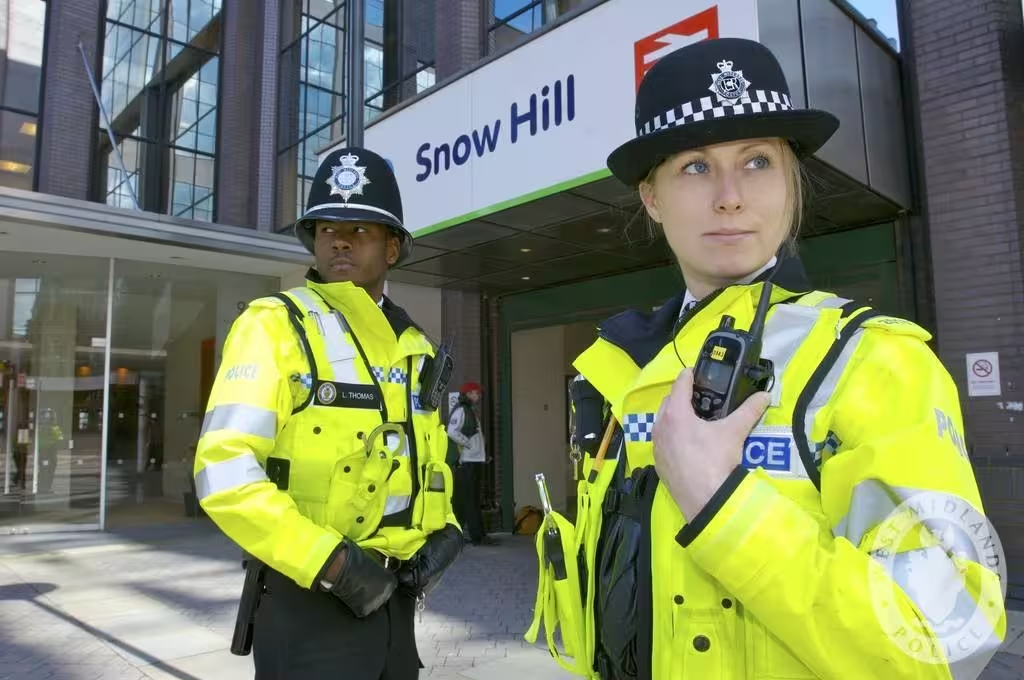
Uniformed police officers of the West Midlands Police
(Australia, New Zealand) Any of the formally enacted law enforcement agencies at various levels of government.

American, Australian, and New Zealand military police with a civilian police officer in Saigon during the Vietnam War, 1965
(usually plural only) The staff of such a department or agency, particularly its officers; (regional, chiefly US, Caribbean, Jamaica, Scotland, countable) an individual police officer.

Oklahoma City Police Department detectives in "plainclothes" attire investigating a homicide crime scene