Sanakirja
Tekoälykääntäjä

Kuvat
12

Ääntäminen
 US
US- Tuntematon aksentti:
- IPA: /ˈplæzmə/
| Kieli | Käännökset |
|---|---|
| espanja | plasma |
| esperanto | plasmo |
| hollanti | plasma |
| italia | plasma, plasmatico |
| japani | プラズマ (purazuma), 血漿 (kesshō) |
| kreikka | πλάσμα (plásma) |
| norja | plasma |
| portugali | plasma |
| puola | plazma, osocze |
| ranska | plasma, plasmatique |
| ruotsi | plasma |
| saksa | Plasma |
| suomi | plasma |
| turkki | plazma |
| tšekki | plazma, plazmový |
| venäjä | пла́зма (plázma), плазма (plazma) |
Määritelmät
Substantiivi
- (physics) A state of matter consisting of partially ionized gas and electrons.
- (hematology) A clear component of blood or lymph containing fibrin.
- (mineralogy) A variety of green quartz, used in ancient times for making engraved ornaments.
- (medicine, dated) A mixture of starch and glycerin, used as a substitute for ointments.
- (biology, archaic) Protoplasm.
- (computer graphics, demoscene) A visual effect in which cycles of changing colours are warped in various ways to give the illusion of liquid organic movement.
Verbi
- (science fiction, transitive) To transform something into plasma.
Esimerkit
- Has anyone here written a plasma demo in C/C++ who would be willing to explain to me exactly how it works?
- plasma membrane
Taivutusmuodot
| Monikko | plasmas |
| Monikko | plasmata |
Luokat
(physics) A state of matter consisting of partially ionized gas and electrons.


Top: Lightning and neon lights are commonplace generators of plasma. Center left: A plasma globe, illustrating some of the more complex plasma phenomena, including filamentation. Center right: A plasma trail from the Space Shuttle Atlantis during re-entry into Earth's atmosphere, as seen from the International Space Station. Bottom left: A fire in a fire pit; fires may produce plasma if hot enough. Bottom right: The Sun's corona as seen from a solar eclipse.
(physics) A state of matter consisting of partially ionized gas and electrons.

Artist's rendition of the Earth's plasma fountain, showing oxygen, helium, and hydrogen ions that gush into space from regions near the Earth's poles. The faint yellow area shown above the north pole represents gas lost from Earth into space; the green area is the aurora borealis, where plasma energy pours back into the atmosphere.
(physics) A state of matter consisting of partially ionized gas and electrons.

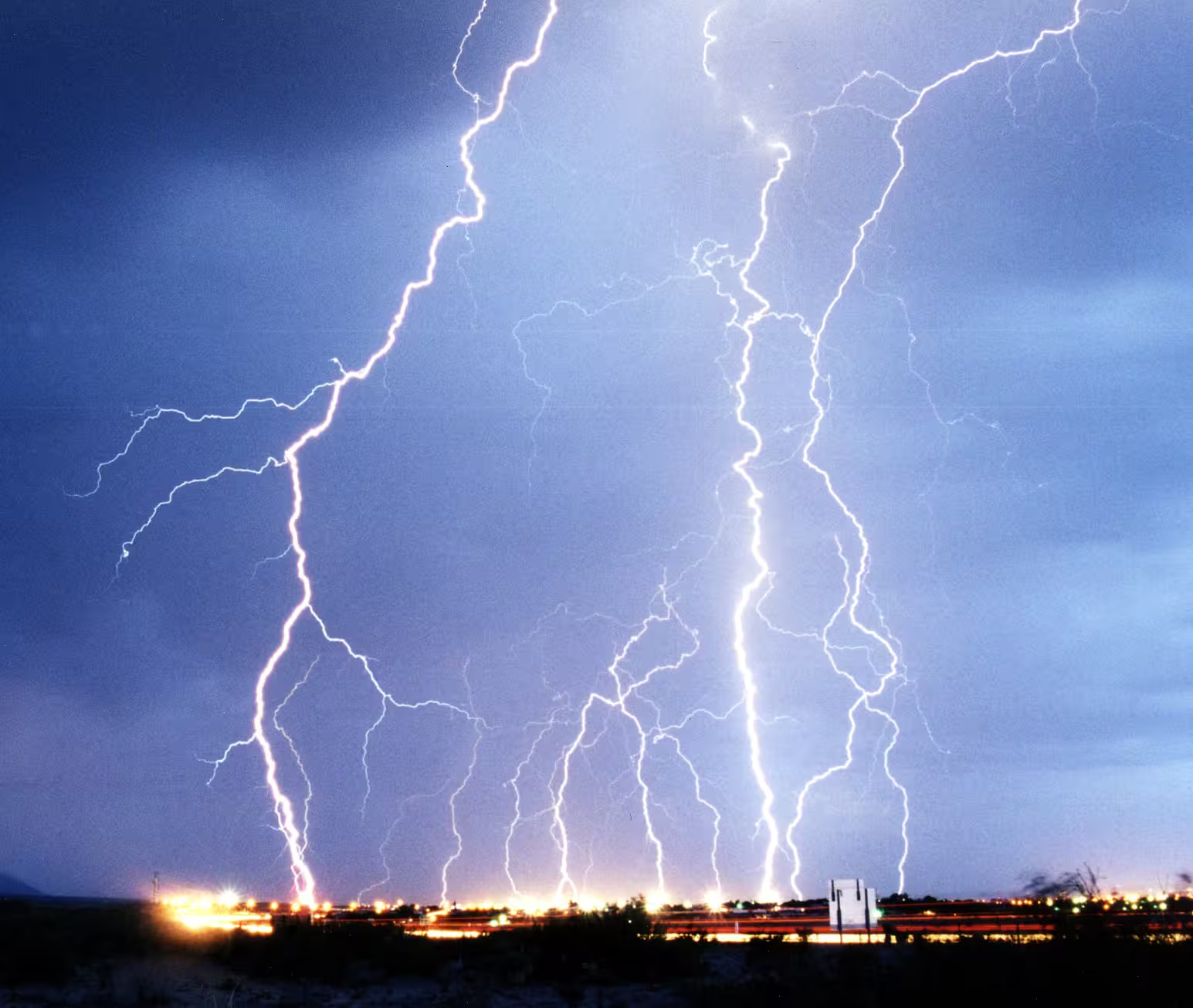
Lightning as an example of plasma present at Earth's surface: Typically, lightning discharges 30 kiloamperes at up to 100 megavolts, and emits radio waves, light, X- and even gamma rays. Plasma temperatures can approach 30000 K and electron densities may exceed 1024 m−3.