Sanakirja
Tekoälykääntäjä

Kuvat
22

Vaihtoehtoiset kirjoitusmuodot
- (vanhentunut) physicks
Ääntäminen
 US
US- Tuntematon aksentti:
- IPA: /ˈfɪz.ɪks/
| Kieli | Käännökset |
|---|---|
| bulgaria | физика (fízika) |
| espanja | física |
| esperanto | fiziko |
| hollanti | natuurkunde, fysica |
| italia | fisica |
| japani | 物理学 (butsurigaku), ぶつりがく (butsurigaku), 物理, 物理學 (butsurigaku) |
| kreikka | φυσική (fysikí) |
| latina | physica, physicalis |
| latvia | fizika |
| liettua | fizika |
| portugali | física |
| puola | fizyka |
| ranska | physique |
| ruotsi | fysik |
| saksa | Physik, physikalisch |
| suomi | fysiikka, luonnontiede |
| tanska | fysik |
| turkki | fizik, doğam |
| tšekki | fyzika |
| unkari | fizika |
| venäjä | физика (fizika), физический (fizitšeski) |
| viro | füüsika |
- Physics on sanan physic monikko.
- Physics on sanan physic yksikön kolmannen persoonan indikatiivin preesens.
Määritelmät
Substantiivi
Esimerkit
- The physics of elementary particles in the 20th century was distinguished by the observation of particles whose existence had been predicted by theorists sometimes decades earlier.
- Newtonian physics was extended by Einstein to explain the effects of travelling near the speed of light; quantum physics extends it to account for the behaviour of atoms.
- The physics of car crashes would not let Tom Cruise walk away like that.
The branch of science concerned with the study of the properties and interactions of space, time, matter and energy.

Classical mechanics works for larger and slower objects; modern theories are needed otherwise.
The physical aspects of a phenomenon or a system, especially those examined or studied scientifically.
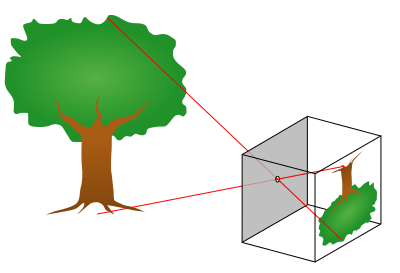
The basic way camera obscura works
The branch of science concerned with the study of the properties and interactions of space, time, matter and energy.

Physics involves modeling the natural world with theory, usually quantitative. Here, the path of a particle is modeled with the mathematics of calculus to explain its behavior: the purview of the branch of physics known as mechanics.