Sanakirja
Tekoälykääntäjä

Kuvat
11

Synonyymit

| Kieli | Käännökset |
|---|---|
| bulgaria | фаланга (falánga) |
| espanja | falange |
| esperanto | falango |
| hollanti | falanx |
| italia | falange |
| japani | ファランクス (fuァrankusu / farankusu), 指骨 (shikotsu), 趾骨 (shikotsu), しこつ (shikotsu) |
| kreikka | φάλαγγα (fálanga) |
| latina | phalanx |
| portugali | falange |
| puola | paliczek |
| ranska | phalange |
| ruotsi | falang, led |
| saksa | Phalanx, Fingerglied, Zehenglied |
| suomi | falangi, varpaanluu, sormiluu, varvasluu |
| tanska | falanks |
| tšekki | článek prstu |
| venäjä | сустав пальца (sustav paltsa), фаланга (falanga) |
Määritelmät
Substantiivi
- (historical, plural phalanxes) An ancient Greek and Macedonian military unit that consisted of several ranks and files (lines) of soldiers in close array with joined shields and long spears.
- (historical sociology) A Fourierite utopian community; a phalanstery.
- (plural phalanxes or (rare) phalanges) A large group of people, animals or things, compact or closely massed, or tightly knit and united in common purpose.
- (anatomy, plural phalanges) One of the bones of the finger or toe.
- (botany) A bundle of stamens, in diadelphous and polyadelphous flowers.
Esimerkit
- There, the Paisleyites were being held back by another phalanx of soldiers and policemen.
- The Guardian today listed a phalanx of ministers who back the bill, including Tessa Jowell, the culture secretary, Tony McNulty, the policing minister, Andy Burnham, the junior health minister, Ian Pearson, the climate change minister, John Healey, the financial secretary to the Treasury, and Keith Hill, parliamentary private secretary to Tony Blair
Taivutusmuodot
| Monikko | phalanxes |
| Monikko | phalanges |
Luokat
(historical, plural phalanxes) An ancient Greek and Macedonian military unit that consisted of several ranks and files (lines) of soldiers in close array with joined shields and long spears.

Sumerian phalanx-like formation c. 2400 BC, from detail of the victory stele of King Eannatum of Lagash over Umma, called the Stele of the Vultures
(historical, plural phalanxes) An ancient Greek and Macedonian military unit that consisted of several ranks and files (lines) of soldiers in close array with joined shields and long spears.

A modern illustration of the Greek hoplites marching in a phalanx formation
(historical, plural phalanxes) An ancient Greek and Macedonian military unit that consisted of several ranks and files (lines) of soldiers in close array with joined shields and long spears.
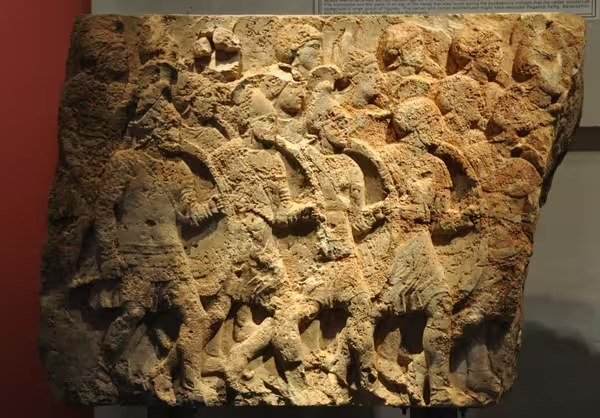
Phalanx in a frieze on the tomb of Pericles, Dynast of Lycia (380–360 BC)