Sanakirja
Tekoälykääntäjä

Vaihtoehtoiset kirjoitusmuodot
- (vanhentunut) matrice

| Kieli | Käännökset |
|---|---|
| espanja | matricial, matriz |
| esperanto | matrico |
| hollanti | matrix, matrijs |
| italia | matriciale, matrice, stampo |
| japani | 行列 (gyōretsu), ぎょうれつ (giョuretsu / gyōretsu) |
| kreikka | μεσοκυττάρια ουσία (mesokyttária ousía / mesokitária ousía), πίνακας (pínakas), μητρώο (mitró'o / mitróo), μήτρα (mítra) |
| latina | alvus |
| liettua | matrica |
| norja | matrise |
| portugali | matriz mitocondrial, matriz |
| puola | matrix, macierz, matryca |
| ranska | matrice, matriciel, moule |
| ruotsi | matris |
| saksa | Matrix |
| suomi | matriisi, taulukko, matriksi, välimassa, maaperä |
| tanska | matrix |
| tšekki | matice |
| unkari | mátrix |
| venäjä | панель (panel), матрица (mátrica / matritsa), материк (materik) |
Määritelmät
Substantiivi
- The cavity or mold in which anything is formed.
- (now rare) The womb.
- The metaphorical place where something is made, formed, or given birth.
- (biology) The material or tissue in which more specialized structures are embedded.
- (biology) An extracellular matrix, the material or tissue between the cells of animals or plants.
- (biology) Part of the mitochondrion.
- (biology) The medium in which bacteria are cultured.
- A table of data.
- (mathematics) A rectangular arrangement of numbers or terms having various uses such as transforming coordinates in geometry, solving systems of linear equations in linear algebra and representing graphs in graph theory.
- (computing) A two-dimensional array.
- (slang, figurative, science fiction) Alternative letter-case form of Matrix; a controlled environment or situation in which people behave in ways that conform to pre-determined roles.
- (electronics) A grid-like arrangement of electronic components, especially one intended for information coding, decoding or storage.
- (geology) A geological matrix.
- (archaeology, paleontology) The sediment surrounding and including the artifacts, features, and other materials at a site.
- (analytical chemistry) The environment from which a given sample is taken.
- (printing, historical) In hot metal typesetting, a mold for casting a letter.
- (printing, historical) In printmaking, the plate or block used, with ink, to hold the image that makes up the print.
- (dyeing) The five simple colours (black, white, blue, red, and yellow) from which all the others are formed.
- (material science) A binding agent of composite materials, e.g. resin in fibreglass.
- (linguistics) Matrix clause is a clause that has another (subordinate) clause embedded within it.
Esimerkit
- upon conception the inward orifice of the matrix exactly closeth, so that it commonly admitteth nothing after [...].
- In very rare cases, when the matrix just goes on pegging away automatically, the doctor can take advantage of that and ease out the second brat who then can be considered to be, say, three minutes younger [...].
Taivutusmuodot
| Monikko | matrices |
| Monikko | matrixes |
Luokat
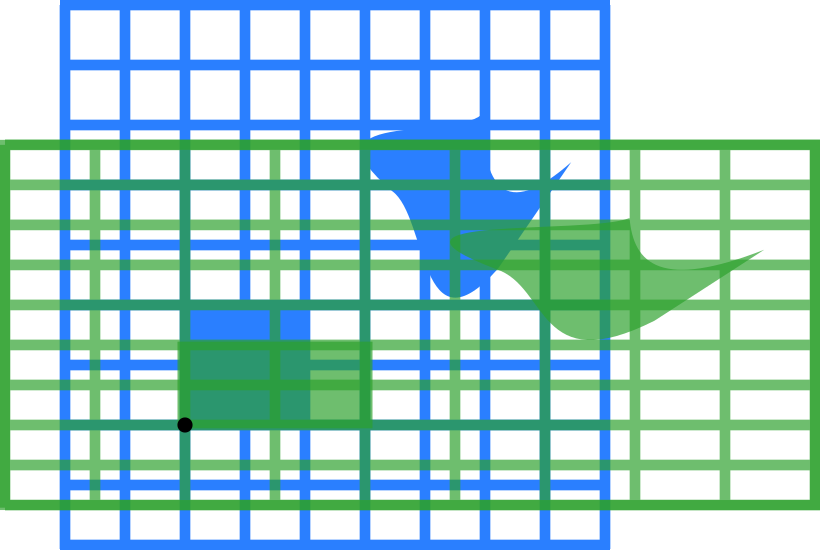
(mathematics) A rectangular arrangement of numbers or terms having various uses such as transforming coordinates in geometry, solving systems of linear equations in linear algebra and representing graphs in graph theory.

An m × n matrix: the m rows are horizontal and the n columns are vertical. Each element of a matrix is often denoted by a variable with two subscripts. For example, a2,1 represents the element at the second row and first column of the matrix.
(computing) A two-dimensional array.

Schematic depiction of the matrix product AB of two matrices A and B

(printing, historical) In hot metal typesetting, a mold for casting a letter.

Matrices created by Jean Jannon around 1640. The Garamond typeface installed with most Microsoft software is based on these designs.
(printing, historical) In printmaking, the plate or block used, with ink, to hold the image that makes up the print.

Placing the dry flong in the casting box.
(material science) A binding agent of composite materials, e.g. resin in fibreglass.

Structure of glass bead’s matrix, including interactions with ionic metals