Sanakirja
Tekoälykääntäjä

Kuvat
8

Ääntäminen
 US
US- Tuntematon aksentti:
- IPA: /ˈɹɛdˌʃɪft/
Määritelmät
Substantiivi
- (physics astronomy, relativity) An increase in the wavelength of a photon or of light, corresponding to a lower frequency and a shift toward the red end of the electromagnetic spectrum.
Verbi
- (physics astronomy, relativity) (ergative) (said of light or a photon) To shift toward the red end of the electromagnetic spectrum; to change to a longer wavelength and a lower frequency.
Taivutusmuodot
| Monikko | redshifts |
(physics astronomy, relativity) An increase in the wavelength of a photon or of light, corresponding to a lower frequency and a shift toward the red end of the electromagnetic spectrum.
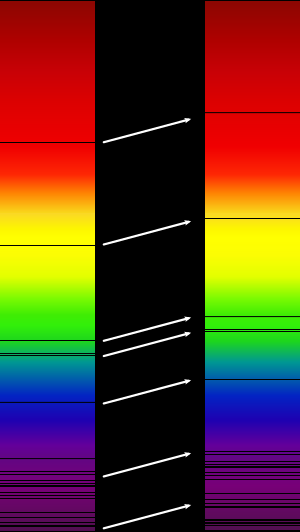
Absorption lines in the visible spectrum of a supercluster of distant galaxies (right), as compared to absorption lines in the visible spectrum of the Sun (left). Arrows indicate redshift. Wavelength increases up towards the red and beyond (frequency decreases).
(physics astronomy, relativity) (ergative) (said of light or a photon) To shift toward the red end of the electromagnetic spectrum; to change to a longer wavelength and a lower frequency.

High-redshift galaxy candidates in the Hubble Ultra Deep Field, 2012
(physics astronomy, relativity) An increase in the wavelength of a photon or of light, corresponding to a lower frequency and a shift toward the red end of the electromagnetic spectrum.
Doppler effect, yellow (c. 575 nm wavelength) ball appears greenish (blueshift to c. 565 nm wavelength) approaching observer, turns orange (redshift to c. 585 nm wavelength) as it passes, and returns to yellow when motion stops. To observe such a change in colour, the object would have to be travelling at approximately 5,200 km/s, or about 32 times faster than the speed record for the fastest space probe.