Sanakirja
Tekoälykääntäjä

Kuvat
8


| Kieli | Käännökset |
|---|---|
| bulgaria | ритъм (rítǎm) |
| espanja | ritmo, compás |
| esperanto | ritmo |
| hollanti | ritme |
| italia | ritmo, cadenza, tempo |
| japani | リズム (rizumu), 拍子 (hyōshi), 音調, おんちょう (onchiョu / onchō) |
| kreikka | ρυθμός (rythmós / riθmós / rythmόs), μέτρο (métro) |
| latina | numerōsitās, modulus, numerus |
| latvia | ritms |
| liettua | ritmas |
| norja | rytme |
| portugali | ritmo, balanço |
| puola | rytm |
| ranska | rythme |
| ruotsi | rytm, takt |
| saksa | Rhythmus, Rhythmik |
| suomi | poljento, tahti, rytmi |
| tanska | rytme, mønster |
| turkki | ritim, ritm, dizem |
| tšekki | takt, rytmus, tempo |
| unkari | ritmus, ütem |
| venäjä | такт (takt), ритм (ritm) |
| viro | rütm |
Määritelmät
Substantiivi
- The variation of strong and weak elements (such as duration, accent) of sounds, notably in speech or music, over time; a beat or meter.
- A specifically defined pattern of such variation.
- A flow, repetition or regularity.
- The tempo or speed of a beat, song or repetitive event.
- The musical instruments which provide rhythm (mainly; not or less melody) in a musical ensemble.
- A regular quantitative change in a variable (notably natural) process.
- Controlled repetition of a phrase, incident or other element as a stylistic figure in literature and other narrative arts; the effect it creates.
- A person's natural feeling for rhythm.
Verbi
- (transitive) To impart a (particular) rhythm to.
Esimerkit
- Dance to the rhythm of the music.
- Most dances have a rhythm as distinctive as the Iambic verse in poetry
- Once you get the rhythm of it, the job will become easy.
- We walked with a quick, even rhythm.
- The Baroque term basso continuo is virtually equivalent to rhythm
- The rhythm of the seasons dominates agriculture as well as wildlife
- The running gag is a popular rhythm in motion pictures and theater comedy
- Listen to the music's rhythm!
Taivutusmuodot
| Monikko | rhythms |
The variation of strong and weak elements (such as duration, accent) of sounds, notably in speech or music, over time; a beat or meter.

Compound triple drum pattern: divides three beats into three; contains repetition on three levels
A specifically defined pattern of such variation.

Metric levels: beat level shown in middle with division levels above and multiple levels below.
A flow, repetition or regularity.
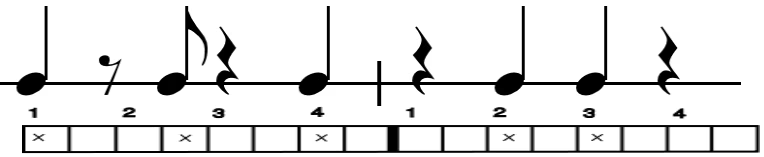
Notation of a clave rhythm pattern: Each cell of the grid corresponds to a fixed duration of time with a resolution fine enough to capture the timing of the pattern, which may be counted as two bars of four beats in divisive (metrical or symmetrical) rhythm, each beat divided into two cells. The first bar of the pattern may also usefully be counted additively (in measured or asymmetrical rhythm) as 3 + 3 + 2.
The musical instruments which provide rhythm (mainly; not or less melody) in a musical ensemble.

Percussion instruments have clearly defined sounds that aid the creation and perception of complex rhythms.