Sanakirja
Tekoälykääntäjä

Kuvat
13

Vaihtoehtoiset kirjoitusmuodot
- (rikkinäinen englanti) knaw
Synonyymit

Määritelmät
Verbi
- (transitive) To perceive the truth or factuality of; to be certain of; to be certain that.
- (intransitive) To be or become aware or cognizant.
- (transitive) To be aware of; to be cognizant of.
- (intransitive, obsolete) To be acquainted (with another person).
- (transitive) To be acquainted or familiar with; to have encountered.
- (transitive, archaic, biblical, euphemistic) To have sexual relations with. This meaning normally specified in modern English as e.g. to 'know someone in the biblical sense' or to 'know biblically'.
- (transitive) To experience.
- To understand or have a grasp of through experience or study.
- (transitive) To be able to distinguish, to discern, particularly by contrast or comparison; to recognize the nature of.
- (transitive) To recognize as the same (as someone or something previously encountered) after an absence or change.
- (intransitive) To have knowledge; to have information, be informed.
- (transitive) To be able to play or perform (a song or other piece of music).
- (transitive) To have indexed and have information about within one's database.
- (transitive, philosophy) To maintain (a belief, a position) subject to a given philosophical definition of knowledge; to hold a justified true belief.
Partikkeli
- (Singlish) Used at the end of a sentence to draw attention to information one thinks the listener should keep in mind.
Substantiivi
- Alternative form of knowe (“hill, knoll”).
- (rare) Knowledge; the state of knowing.
- Knowledge; the state of knowing. (Now confined to the fixed phrase in the know.)
Esimerkit
- I know that I’m right and you’re wrong.
- He knew something terrible was going to happen.
- Did you know Michelle and Jack were getting divorced? ― Yes, I knew.
- She knows where I live.
- I knew he was upset, but I didn't understand why.
- I stumbled along through the young pines and huckleberry bushes. Pretty soon I struck into a sort of path that, I cal'lated, might lead to the road I was hunting for. It twisted and turned, and, the first thing I knew, made a sudden bend around a bunch of bayberry scrub and opened out into a big clear space like a lawn.
- I know your mother, but I’ve never met your father.
- I was about to say that I had known the Celebrity from the time he wore kilts. But I see I will have to amend that, because he was not a celebrity then, nor, indeed, did he achieve fame until some time after I left New York for the West.
- Their relationship knew ups and downs.
- The Truman family knew good times and bad,.
- to know a person's face or figure;
- to know right from wrong;
- I wouldn't know one from the other.
- Ye shall know them by their fruits.
- The Bat—they called him the Bat.. He'd never been in stir, the bulls had never mugged him, he didn't run with a mob, he played a lone hand, and fenced his stuff so that even the fence couldn't swear he knew his face.
- Flares do not know friend from foe and so illuminate both. Changes in wind direction can result in flare exposure of the attacker while defenders hide in the shadows.
- At nearer view he thought he knew the dead, / And call'd the wretched man to mind.
- Ernest also is so much improved, that you would hardly know him:.
- Let me do it. I know how it works.
- She knows how to swim.
- She knows chemistry better than anybody else.
- Know your enemy and know yourself.
- The yawning gap in neuroscientists’ understanding of their topic is in the intermediate scale of the brain’s anatomy. Science has a passable knowledge of how individual nerve cells, known as neurons, work. It also knows which visible lobes and ganglia of the brain do what. But how the neurons are organised in these lobes and ganglia remains obscure.
- And Adam knew Eve his wife; and she conceived, and bare Cain, and said, I have gotten a man from the LORD.
- It is vital that he not know.
- She knew of our plan.
- He knows about 19th century politics.
- “My Continental prominence is improving,” I commented dryly. ¶ Von Lindowe cut at a furze bush with his silver-mounted rattan. ¶ “Quite so,” he said as dryly, his hand at his mustache. “I may say if your intentions were known your life would not be worth a curse.”
- Manganism has been known about since the 19th century, when miners exposed to ores containing manganese, a silvery metal, began to totter, slur their speech and behave like someone inebriated.
- You and I have known, sir.
- That on the view and know of these Contents, [...] He should the bearers put to [...] death,
- He soon arrived at the house of his brother, who hardly knew him. He was wild-eyed, haggard, and grey as a rat. ISBN 978-0-141-03881-0
- — Vous savez, Mr. Thatcher, avec un déficit d’un million de dollars par ans, je devrai fermer dans… 60 ans
- — I think I can take the subway to the airport. Do you know where the subway is? — Sure, it’s over there.
- Has she heard? Yes, she knows.
- Does he know about it?
- Yes, I know that I drove too fast
- She knows chemistry better than anyone else I know
- I know his mother, but I never met his father
- No, I won't lend you any money since I know you!
Taivutusmuodot
| Partisiipin perfekti | known | Partisiipin perfekti | knowed (epävirallinen) |
| Partisiipin perfekti | knowen (vanhahtava) | Partisiipin perfekti | know'd (vanhahtava) |
| Partisiipin perfekti | yknown | Partisiipin perfekti | yknowe |
| Imperfekti | knew | Imperfekti | knowed (epävirallinen) |
| Imperfekti | know'd (vanhahtava) | Partisiipin preesens | knowing |
| Monikko | knows | Yksikön kolmannen persoonan indikatiivin preesens | knows |
| Yksikön kolmannen persoonan indikatiivin preesens | knoweth (vanhahtava) |
Luokat
(rare) Knowledge; the state of knowing.

The owl of Athena, a symbol of knowledge in the Western world
(rare) Knowledge; the state of knowing.

The definition of knowledge as justified true belief is often discussed in the academic literature.
(rare) Knowledge; the state of knowing.
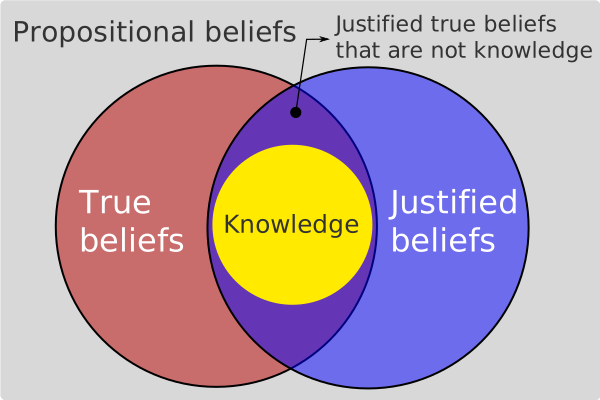
The Gettier problem is grounded in the idea that some justified true beliefs do not amount to knowledge.