Sanakirja
Tekoälykääntäjä


| Kieli | Käännökset |
|---|---|
| espanja | fisión nuclear |
| hollanti | nucleaire fusie, kernfusie |
| italia | fissione nucleare |
| japani | 核分裂 (kakubunretsu), 原子核分裂 (genshikakubunretsu), げんしかくぶんれつ (genshikakubunretsu) |
| portugali | fissão nuclear |
| ranska | fission nucléaire |
| ruotsi | fission, kärnklyvning |
| saksa | Kernspaltung |
| suomi | fissio, fissioreaktio, ydinfissio |
| tanska | kernespaltning |
| tšekki | jaderné štěpení |
| unkari | maghasadás |
| venäjä | я́дерное деле́ние (jádernoje delénije), деле́ние ядра́ (delénije jadrá) |
Määritelmät
Substantiivi
- (nuclear physics) A nuclear reaction in which a large nucleus splits into smaller ones, sometimes accompanied by the simultaneous release of energy.
Taivutusmuodot
| Monikko | nuclear fissions |
Luokat
(nuclear physics) A nuclear reaction in which a large nucleus splits into smaller ones, sometimes accompanied by the simultaneous release of energy.
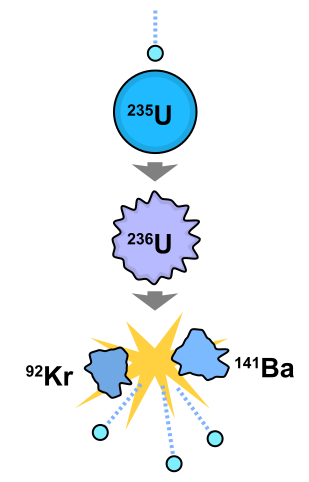
Induced fission reaction. A neutron is absorbed by a uranium-235 nucleus, turning it briefly into an excited uranium-236 nucleus, with the excitation energy provided by the kinetic energy of the neutron plus the forces that bind the neutron. The uranium-236, in turn, splits into fast-moving lighter elements (fission products) and releases several free neutrons, one or more "prompt gamma rays" (not shown) and a (proportionally) large amount of kinetic energy.
(nuclear physics) A nuclear reaction in which a large nucleus splits into smaller ones, sometimes accompanied by the simultaneous release of energy.
A visual representation of an induced nuclear fission event where a slow-moving neutron is absorbed by the nucleus of a uranium-235 atom, which fissions into two fast-moving lighter elements (fission products) and additional neutrons. Most of the energy released is in the form of the kinetic velocities of the fission products and the neutrons.
(nuclear physics) A nuclear reaction in which a large nucleus splits into smaller ones, sometimes accompanied by the simultaneous release of energy.
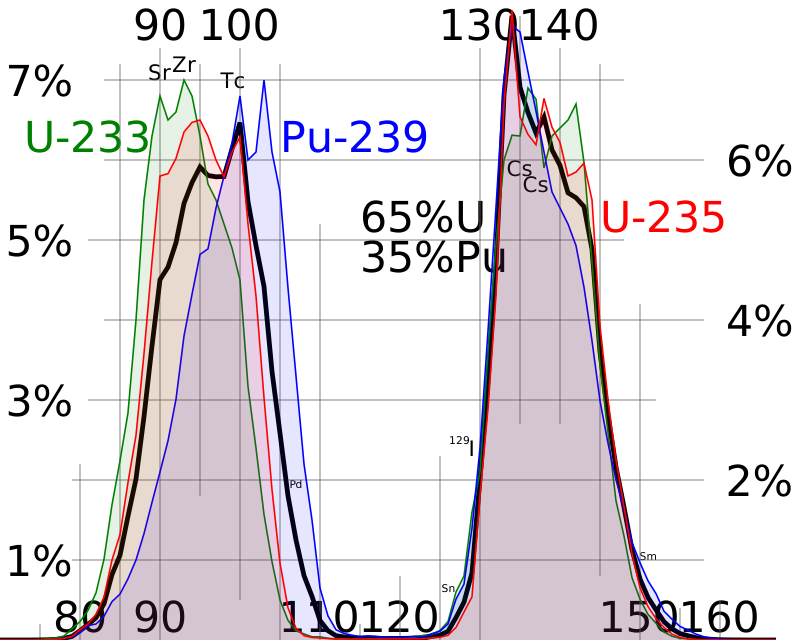
Fission product yields by mass for thermal neutron fission of uranium-235, plutonium-239, a combination of the two typical of current nuclear power reactors, and uranium-233, used in the thorium cycle