Sanakirja
Tekoälykääntäjä

Kuvat
3

Ääntäminen
 Southern England
- US:
- IPA: /ˈstɪm.jə.ləs/
| Kieli | Käännökset |
|---|---|
| espanja | estímulo, incentivo |
| esperanto | sprono |
| italia | stimolo, sollecitazione |
| japani | 刺激 (shigeki), しげき (shigeki) |
| latina | prōvocātiō, calcar, stimulus |
| portugali | estímulo |
| puola | bodziec |
| ranska | stimulus, incitation, incitant |
| ruotsi | stimulans |
| saksa | Stimulus, Auslöseimpuls, Aufschwung, Reiz, Anregung |
| suomi | ärsyke, kannuste, kiihoke, vaikute, elvytys, stimulus, piriste, virike, heräte, elvyke, kimmoke, ponnin |
| tšekki | podnět |
| unkari | inger |
| venäjä | побудитель (pobuditel), стимулятор (stimuljator), стимул (stimul) |
Määritelmät
Substantiivi
- An external phenomenon that has an influence on a system, by triggering or modifying an internal phenomenon; for example, a spur or incentive that drives a person to take action or change behaviour.
- (physiology, psychology, medicine) Something external that elicits or influences a physiological or psychological activity or response, or that affects any of the sensory apparatuses.
- (botany, entomology) A stinging part on the body of a plant or insect.
Esimerkit
- an economic stimulus
- Democrats, meanwhile, point out that Republicans seem to have made a conscious decision, beginning with the stimulus, to oppose anything the president put forward, dooming any chance of renewed cooperation between the parties.
Taivutusmuodot
| Monikko | stimuli |
| Monikko | stimuluses |
Luokat
An external phenomenon that has an influence on a system, by triggering or modifying an internal phenomenon; for example, a spur or incentive that drives a person to take action or change behaviour.

Typical intervention strategies under different conditions
(physiology, psychology, medicine) Something external that elicits or influences a physiological or psychological activity or response, or that affects any of the sensory apparatuses.

The light from the lamp (1.) functions as a detectable change in the plant's environment. As a result, the plant exhibits a reaction of phototropism—directional growth (2.) toward the light stimulus.
(physiology, psychology, medicine) Something external that elicits or influences a physiological or psychological activity or response, or that affects any of the sensory apparatuses.
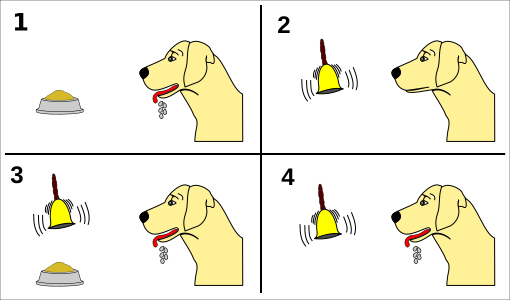
Sequential illustration of Pavlov's dog experiment