Sanakirja
Tekoälykääntäjä

Kuvat
4

Synonyymit
| Kieli | Käännökset |
|---|---|
| ruotsi | klassisk betingning |
Määritelmät
Substantiivi
- (psychology) A learning process in which a previously neutral stimulus (such as a bell) is paired with a potent stimulus (such as food in the case of a dog), so that the neutral stimulus comes to elicit a conditioned response (salivation) similar to the one elicited by the potent stimulus.
Luokat
(psychology) A learning process in which a previously neutral stimulus (such as a bell) is paired with a potent stimulus (such as food in the case of a dog), so that the neutral stimulus comes to elicit a conditioned response (salivation) similar to the one elicited by the potent stimulus.

Ivan Pavlov research on dog's reflex setup
(psychology) A learning process in which a previously neutral stimulus (such as a bell) is paired with a potent stimulus (such as food in the case of a dog), so that the neutral stimulus comes to elicit a conditioned response (salivation) similar to the one elicited by the potent stimulus.
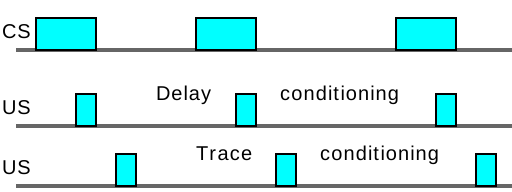
Diagram representing forward conditioning. The time interval increases from left to right.
(psychology) A learning process in which a previously neutral stimulus (such as a bell) is paired with a potent stimulus (such as food in the case of a dog), so that the neutral stimulus comes to elicit a conditioned response (salivation) similar to the one elicited by the potent stimulus.

Classical conditioning procedures and effects