Sanakirja
Tekoälykääntäjä

Kuvat 2

Vaihtoehtoiset kirjoitusmuodot

Ääntäminen

  • ÄäntäminenConnecticut:
    • IPA: /ˈkoʊˈvɛɹ.i.əns/
  • UK:
    • IPA: /kəʊˈvɛː.ɹi.əns/
  • non-Mary-marry-merry:
    • IPA: /koʊˈvæɹ.i.əns/
  • US:
    • IPA: /koʊˈvæɹ.i.əns/
    • IPA: /ˈkoʊˈvɛɹ.i.əns/
  • Mary-marry-merry:
    • IPA: /ˈkoʊˈvɛɹ.i.əns/
  • AU:
    • IPA: /kəʉˈveː.ɹi.əns/
KieliKäännökset
espanjacovariación
esperantokunvarianco
hollanticovariantie
italiacovarianza
portugalicovariância
puolakowariancja
ranskacovariance
suomikovarianssi
turkkikovaryans
tšekkikovariance
venäjäковариация (kovariatsija)

Määritelmät

Substantiivi

  1. (statistics) A statistical measure defined as Cov(X,Y)=E((Xμ)(Yν)){\displaystyle \scriptstyle \operatorname {Cov} (X,Y)=\operatorname {E} ((X-\mu )(Y-\nu ))} given two real-valued random variables X and Y, with expected values E(X)=μ{\displaystyle \scriptstyle E(X)\,=\,\mu } and E(Y)=ν{\displaystyle \scriptstyle E(Y)\,=\,\nu }.
  2. (object-oriented programming) The conversion of data types from wider to narrower in certain situations.

Taivutusmuodot

Monikkocovariances

(statistics) A statistical measure defined as Cov(X,Y)=E((Xμ)(Yν)){\displaystyle \scriptstyle \operatorname {Cov} (X,Y)=\operatorname {E} ((X-\mu )(Y-\nu ))} given two real-valued random variables X and Y, with expected values E(X)=μ{\displaystyle \scriptstyle E(X)\,=\,\mu } and E(Y)=ν{\displaystyle \scriptstyle E(Y)\,=\,\nu }.

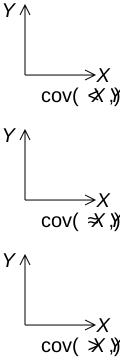
The sign of the covariance of two random variables X and Y

(statistics) A statistical measure defined as Cov(X,Y)=E((Xμ)(Yν)){\displaystyle \scriptstyle \operatorname {Cov} (X,Y)=\operatorname {E} ((X-\mu )(Y-\nu ))} given two real-valued random variables X and Y, with expected values E(X)=μ{\displaystyle \scriptstyle E(X)\,=\,\mu } and E(Y)=ν{\displaystyle \scriptstyle E(Y)\,=\,\nu }.

Geometric interpretation of the covariance example. Each cuboid is the axis-aligned bounding box of its point (x, y, f (x, y)), and the X and Y means (magenta point). The covariance is the sum of the volumes of the cuboids in the 1st and 3rd quadrants (red) and in the 2nd and 4th (blue).