Sanakirja
Tekoälykääntäjä

Kuvat
10

Vaihtoehtoiset kirjoitusmuodot
- (harvinainen) time dilatation
| Kieli | Käännökset |
|---|---|
| espanja | dilatación del tiempo |
| puola | dylatacja czasu |
| ranska | dilatation du temps |
| ruotsi | tidsdilatation |
| saksa | Zeitdilatation |
| suomi | aikadilataatio, aikadilaatio |
Määritelmät
Substantiivi
- (relativity) The slowing of the passage of time experienced by objects in motion relative to an observer (measurable only at relativistic speeds), or due to being in a gravitational well.
- (psychology) The perceived change in the speed of time experienced due to psychological stress, hormones, or drugs; the rate of time perception, chronoception.
Taivutusmuodot
| Monikko | time dilations |
Luokat
(relativity) The slowing of the passage of time experienced by objects in motion relative to an observer (measurable only at relativistic speeds), or due to being in a gravitational well.
From the local frame of reference of the blue clock, the red clock, being in motion, is measured as ticking slower.
(relativity) The slowing of the passage of time experienced by objects in motion relative to an observer (measurable only at relativistic speeds), or due to being in a gravitational well.
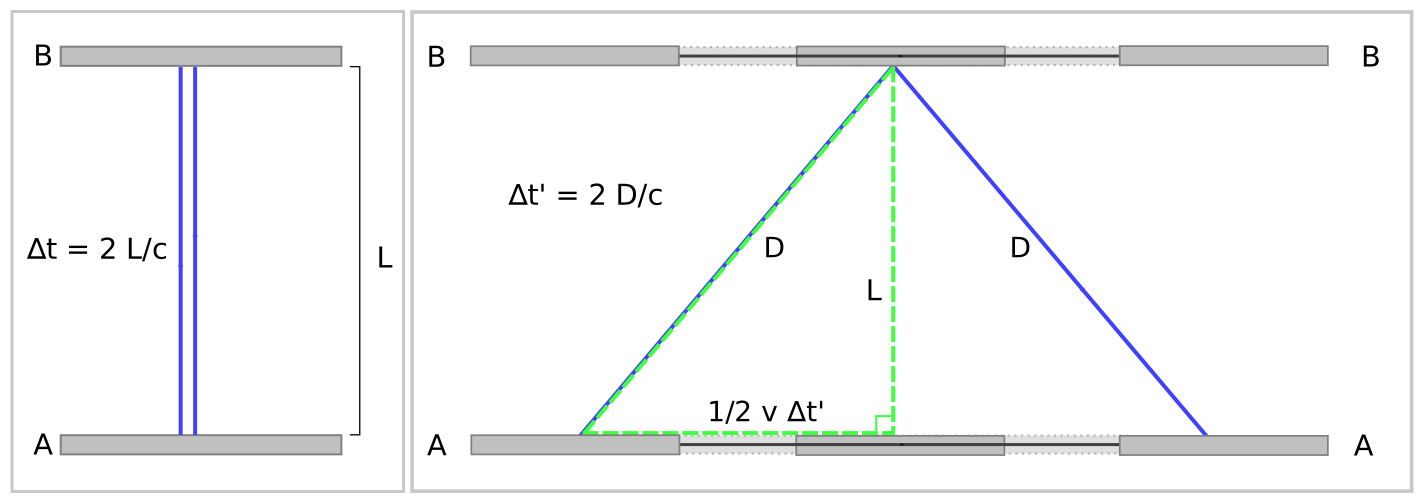
Left: Observer at rest measures time 2L/c between co-local events of light signal generation at A and arrival at A. Right: Events according to an observer watching as the mirror setup moves to the right: bottom mirror A when signal is generated at time t'=0, top mirror B when signal gets reflected at time t'=D/c, bottom mirror A when signal returns at time t'=2D/c
(relativity) The slowing of the passage of time experienced by objects in motion relative to an observer (measurable only at relativistic speeds), or due to being in a gravitational well.
Transversal time dilation. The blue dots represent a pulse of light. Each pair of dots with light "bouncing" between them is a clock. In the frame of each group of clocks, the other group is measured to tick more slowly, because the moving clock's light pulse has to travel a larger distance than the stationary clock's light pulse. That is so, even though the clocks are identical and their relative motion is perfectly reciprocal.