Sanakirja
Tekoälykääntäjä

Kuvat
1


| Kieli | Käännökset |
|---|---|
| espanja | bosón |
| hollanti | boson |
| italia | bosone |
| japani | ボース粒子 (bōsu-ryūshi / bōsuryūshi), ボソン (boson) |
| kreikka | μποζόνιο (bozónio) |
| latina | boson |
| portugali | bóson, bosão |
| puola | bozon |
| ranska | boson |
| ruotsi | boson |
| saksa | Boson |
| suomi | bosoni |
| turkki | bozon |
| unkari | bozon |
| venäjä | бозо́н (bozón), бозон (bozon) |
Määritelmät
Substantiivi
- (particle physics) A particle with totally symmetric composite quantum states, which exempts them from the Pauli exclusion principle, and that hence obeys Bose-Einstein statistics. They have integer spin. Among them are many elementary particles, and some (gauge bosons) are known to carry the fundamental forces. Compare fermion.
- (obsolete) A boatswain.
Taivutusmuodot
| Monikko | bosons |
(particle physics) A particle with totally symmetric composite quantum states, which exempts them from the Pauli exclusion principle, and that hence obeys Bose-Einstein statistics. They have integer spin. Among them are many elementary particles, and some (gauge bosons) are known to carry the fundamental forces. Compare fermion.
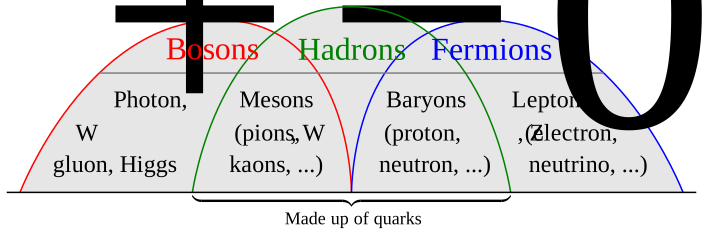
Bosons form one of the two fundamental classes of subatomic particle, the other being fermions. All subatomic particles must be one or the other. A composite particle (hadron) may fall into either class depending on its composition.