Sanakirja
Tekoälykääntäjä

Kuvat
10

Vaihtoehtoiset kirjoitusmuodot
- (vanhentunut) kitchin
Synonyymit

| Kieli | Käännökset |
|---|---|
| bulgaria | ку́хня, кухня |
| espanja | cocina |
| esperanto | kuirejo |
| hollanti | keuken, kombuis |
| italia | cucina |
| japani | 厨房 (chūbō), 台所 (daidokoro), キッチン (kitchin), だいどころ (daidokoro), くりや (kuriya), 板前, 勝手 (katte), かって (katte) |
| kreikka | μαγειρείο (mageireío), κουζίνα (kouzína / kuzína / koozína) |
| latina | coquina, culīna, culīnārius, culīnaris, coquīna |
| latvia | virtuve |
| liettua | virtuve |
| portugali | cozinha |
| puola | kuchnia |
| ranska | cuisine |
| ruotsi | kök |
| saksa | Küche, Kinder, Küche, Kirche |
| suomi | keittiö, kyökki |
| tanska | køkken |
| turkki | mutfak |
| tšekki | kuchyně, kuchyňský |
| unkari | konyha |
| venäjä | ку́хня (kúhnja), кухня (kuhnja), кухонный (kuhonnyi), котёл (kotjol) |
| viro | köök |
Määritelmät
Substantiivi
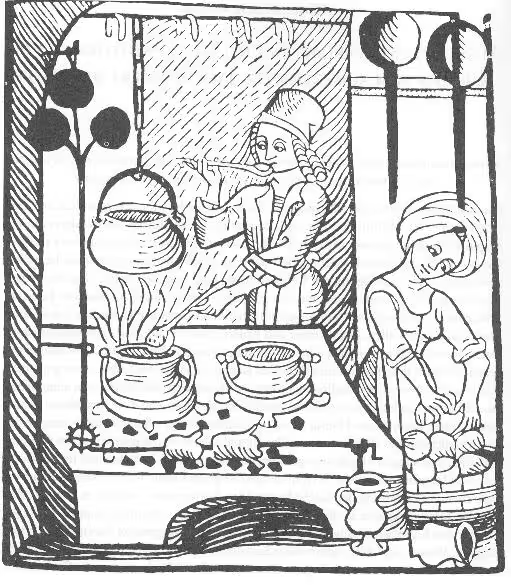
- A room or area for preparing food.
- (by extension) Cuisine; style of cooking.
- (chiefly African-American Vernacular) The nape of a person's hairline, often referring to its uncombed or "nappy" look.
- (music) The percussion section of an orchestra.
- (dated) A utensil for roasting meat.
- (attributive) A domesticated or uneducated form of a language.
- (slang) A public gaming room in a casino.
- (obsolete) Anything eaten as a relish with bread, potatoes, etc.; a condiment.
- The region of a billiard table between the head rail and the head string.
Verbi
Esimerkit
- Everything a living animal could do to destroy and to desecrate bed and walls had been done. […] A canister of flour from the kitchen had been thrown at the looking-glass and lay like trampled snow over the remains of a decent blue suit with the lining ripped out which lay on top of the ruin of a plastic wardrobe.
- Sir Henry and Umbopo sat conversing in a mixture of broken English and kitchen Zulu, in low voices, but earnestly enough.
- For obvious reasons the percussion is normally arranged along the back of the platform, whether centrally or to one side, and sometimes also in two tiers, the heavy, noisier instruments behind, and the pitched, agile instruments such as vibraphone, marimba, etc. in front. An outstanding exception, however, exists in Roberto Gerhard's Epithalamion where the composer expressly desired that the all-important kitchen department be spread out in front of the strings and hence nearest the audience.
- a tin kitchen
Taivutusmuodot
| Monikko | kitchens |