Sanakirja
Tekoälykääntäjä


Vaihtoehtoiset kirjoitusmuodot
- (vanhentunut) algorism
Synonyymit

| Käännös | Konteksti | |
|---|---|---|
| Substantiivit | ||
| 1. | アルゴリズム (arugorizumu) | |
| 2. | 演算手順 (enzantejun) | |
| 3. | 算法 (sanpō) | vanhahtava |
Määritelmät
Substantiivi
- (countable) A collection of ordered steps that solve a mathematical problem. A precise step-by-step plan for a computational procedure that possibly begins with an input value and yields an output value in a finite number of steps.
- (loosely) A flowchart illustrating a decision-making process for human users, especially health care professionals.
- (uncountable, obsolete) Calculation with Arabic numerals; algorism.
- (social media, metonymic) recommender systems and the curation of feeds
- (usually preceded by definite article "the") software that makes content display determinations on a platform, in totality of effect upon all end users (within a potential audience).
- (informal, by extension of above) the influenced zeitgeist: e.g. what content ends up trending or viral, what persons become a main character or cancelled
- (informal, usually preceded by a possessive determiner) the actual personalized selections of content seen by specific user(s), the microtargeting to which they are subject
Esimerkit
- Informally, an algorithm is any well-defined computational procedure that takes some value, or set of values, as input and produces some value, or set of values, as output. An algorithm is thus a sequence of computational steps that transform the input into the output.
- The use of algorithms in policing is one example of their increasing influence on our lives. And, as their ubiquity spreads, so too does the debate around whether we should allow ourselves to become so reliant on them – and who, if anyone, is policing their use.
- Fibonacci algorithm implemented in popular programming languages
Taivutusmuodot
| Monikko | algorithms |
Luokat
(countable) A collection of ordered steps that solve a mathematical problem. A precise step-by-step plan for a computational procedure that possibly begins with an input value and yields an output value in a finite number of steps.
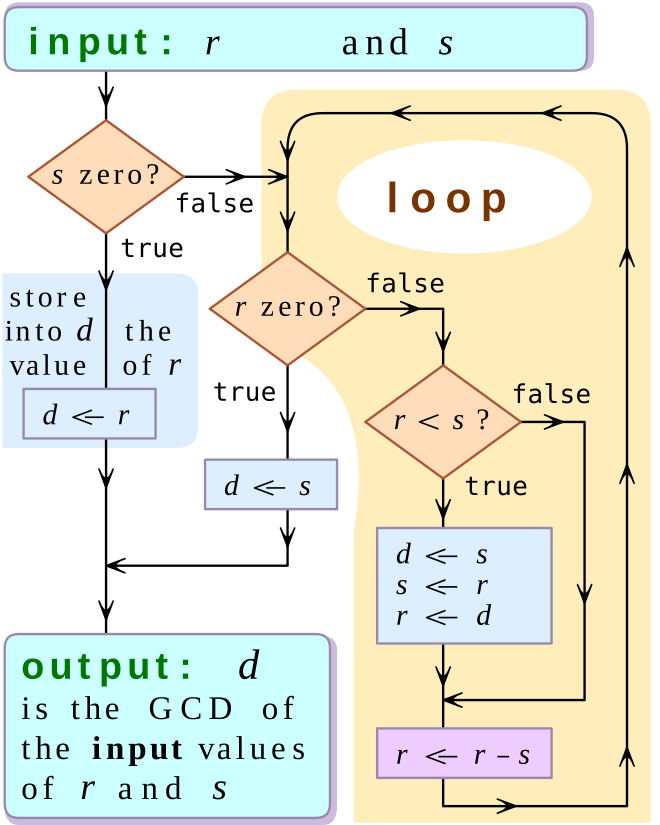
Flowchart of using successive subtractions to find the greatest common divisor of number r and s
(countable) A collection of ordered steps that solve a mathematical problem. A precise step-by-step plan for a computational procedure that possibly begins with an input value and yields an output value in a finite number of steps.

Ada Lovelace's diagram from "Note G", the first published computer algorithm