Sanakirja
Tekoälykääntäjä

Kuvat
1


| Kieli | Käännökset |
|---|---|
| hollanti | zullen |
| italia | dovere, essere obbligato di |
| japani | べし (beshi) |
| kreikka | θα (tha) |
| latina | debeo |
| norja | skal, skulle |
| portugali | precisar, dever |
| ranska | devoir, être obligé de |
| ruotsi | böra, skola, ska |
| saksa | sollen |
| suomi | pitää, jonkun on määrä, sattua, tapahtua sattumalta |
| tanska | ville |
| venäjä | до́лжен (dólžen), должна́ (dolžná), должно́ (dolžnó), должны́ (dolžný) |
Määritelmät
Verbi
- Used before a verb to indicate the simple future tense in the first person singular or plural.
- Used similarly to indicate determination or obligation in the second and third persons singular or plural.
- Used in questions with the first person singular or plural to suggest a possible future action.
- (obsolete) To owe.
Esimerkit
- "My third command to the Winged Monkeys," said Glinda, "shall be to carry you to your forest. Then, having used up the powers of the Golden Cap, I shall give it to the King of the Monkeys, that he and his band may thereafter be free for evermore."
- : You shall go to the ball!
- : Citizens shall provide proof of identity.
- Rule, Britannia! Britannia, rule the waves: Britons never, never, never shall be slaves.
- I shall sing tomorrow.
- In brightest day, in blackest night, No evil shall escape my sight. Let those who worship evil’s might, Beware my power… Green Lantern’s light!
- Citizens shall provide identity.
- I swear to devote my life to the destruction of piracy, greed, cruelty, and injustice, in all their forms! My sons and their sons, shall follow me.
- I shall sing in the choir tomorrow.
- Shall we go out later?
- Beslutsamhet: You shall go to the ball!
- Skyldighet: Citizens shall provide proof of identity.
- If it should rain, the gig would be held indoors.
Taivutusmuodot
| Imperfekti | should |
Luokat
Used similarly to indicate determination or obligation in the second and third persons singular or plural.
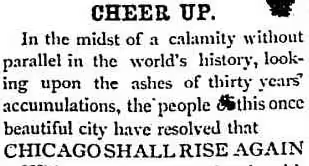
Example of shall in the lead editorial of the Chicago Tribune after the Chicago Fire, using "shall" to connote formality and seriousness.