Sanakirja
Tekoälykääntäjä



| Kieli | Käännökset |
|---|---|
| bulgaria | взаимно прости (vzaimno prosti) |
| japani | 互いに素 (tagai ni so), 互いに素な (tagai ni sona) |
| portugali | coprimo |
| puola | względnie pierwsze, względnie pierwsza |
| ranska | premiers entre eux |
| ruotsi | relativt prima, relativt prim |
| saksa | teilerfremd |
| tšekki | nesoudělný |
| unkari | relatív prímek, relatív prím |
| venäjä | взаи́мно просто́й (vzaímno prostói), взаи́мно просты́е (vzaímno prostýje) |
Määritelmät
Adjektiivi
- (number theory, of two or more positive integers) Having no positive integer factors in common, aside from 1.
- (number theory, of a positive integer) Having no positive integer factors, aside from 1, in common with one or more specified other positive integers.
- (algebra, by extension, of two or more polynomials) Whose greatest common divisor is a nonzero constant (i.e., polynomial of degree 0).
- (ring theory, by extension) (of two or more ideals of a ring) Whose sum is the whole ring; (of two or more elements of a ring) generating the whole ring.
Esimerkit
- 24 and 35 are coprime.
- 24 is coprime to 35.
Luokat
(number theory, of two or more positive integers) Having no positive integer factors in common, aside from 1.
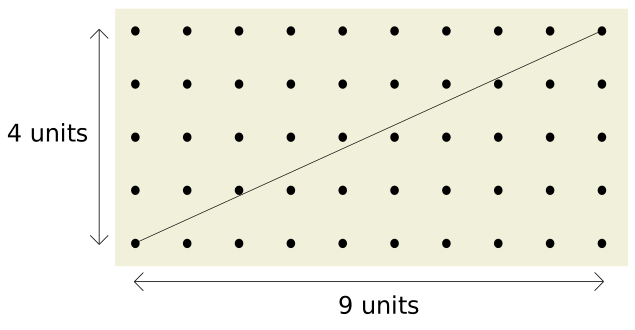
Figure 1. The numbers 4 and 9 are coprime. Therefore, the diagonal of a 4 × 9 lattice does not intersect any other lattice points
(number theory, of two or more positive integers) Having no positive integer factors in common, aside from 1.

The tree rooted at (2, 1). The root (2, 1) is marked red, its three children are shown in orange, third generation is yellow, and so on in the rainbow order.