Sanakirja
Tekoälykääntäjä



| Kieli | Käännökset |
|---|---|
| espanja | inteligencia artificial |
| hollanti | kunstmatige intelligentie |
| italia | intelligenza artificiale |
| japani | 人工知能 (じんこうちのう, jinkō chinō / jinkōchinō), アーティフィシャルインテリジェンス (āteィfuィshiャruinterijiェnsu / ātifisharuinterijensu) |
| kreikka | τεχνητή νοημοσύνη (technití noimosýni) |
| portugali | inteligência artificial |
| puola | sztuczna inteligencja |
| ranska | intelligence artificielle |
| ruotsi | artificiell intelligens |
| saksa | künstliche Intelligenz |
| suomi | äly, tekoäly, keinoäly |
| tanska | kunstig intelligens |
| tšekki | umělá inteligence |
| unkari | mesterséges intelligencia |
| venäjä | ИИ́ (IÍ), иску́сственный интелле́кт (iskússtvennyi intellékt), искусственный интеллект (iskusstvennyi intellekt) |
Määritelmät
Substantiivi
- Intelligence exhibited by an artificial (nonnatural, humanmade) entity.
- (computer science) The branch of computer science dealing with the reproduction or mimicking of human-level intelligence, self-awareness, knowledge, conscience, and thought in computer programs.
- The essential quality of a machine which thinks in a manner similar to or on the same general level as a real human being.
- (video games) A character or entity controlled by the game instead of a player; AI.
- (computing) A computer system or software package which is artificially intelligent.
- (countable, chiefly science fiction) An intelligent, self-aware computer or computer program.
- (proscribed, specifically) Synonym of generative artificial intelligence.
Esimerkit
- Research in the modern science of Artificial Intelligence started only in the 1950's, stimulated by the invention of modern computers. This inspired a flood of new ideas about how machines could do what only minds had done previously.
- This comupter possesses artificial intelligence.
- The original Sniper: Ghost Warrior was a surprise hit when it was released in 2010. A surprise because it seemed an unequivocally awful game, with half broken graphics and artificial intelligence, a tediously linear story campaign, and an undernourished multiplayer mode.
- While the humans scurried in confusion, the Artificial Intelligence (AI) created by MIT/Bell Labs linked itself into the network of high-speed, twentieth generation computers placed at its disposal by a Red Alert Priority, evaluated data thoughtfully for a minute and a half and then proceeded to get in touch with its opposite number in the Russian Republics.
- What Daedadus really is, is the world's first successful wholly autonomous AI. Whatever mysterious organization managed to create the first true artificial intelligence succeeded so well that their creation managed to convince them that they'd failed... and then escaped.
- Dylan Hunt: "This is Captain Dylan Hunt of the High Guard. Investigation has shown that an Artificial Intelligence was involved in the tragic death of your President. In such a case, Commonwealth law demands that the AI's personality be completely erased."
- Also remember that Skynet's an artificial intelligence. Intelligence, for our purpose, means being able to use reason in order to achieve your goals.
Taivutusmuodot
| Monikko | artificial intelligences |
Luokat
(computer science) The branch of computer science dealing with the reproduction or mimicking of human-level intelligence, self-awareness, knowledge, conscience, and thought in computer programs.

In supervised learning, the training data is labelled with the expected answers, while in unsupervised learning, the model identifies patterns or structures in unlabelled data.
The essential quality of a machine which thinks in a manner similar to or on the same general level as a real human being.
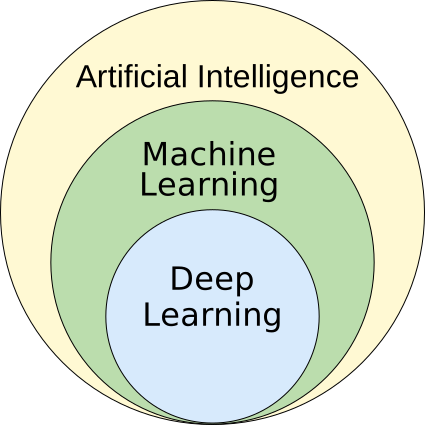
Deep learning is a subset of machine learning, which is itself a subset of artificial intelligence.
