Sanakirja
Tekoälykääntäjä

Kuvat
8

Vaihtoehtoiset kirjoitusmuodot

| Kieli | Käännökset |
|---|---|
| espanja | topoisomerasa |
| italia | topoisomerasi |
Määritelmät
Substantiivi
- (biochemistry) Any of several enzymes that affect the topology of DNA, especially ones that relax supercoiling.
Taivutusmuodot
| Monikko | topoisomerases |
Luokat
(biochemistry) Any of several enzymes that affect the topology of DNA, especially ones that relax supercoiling.

Figure 1. Overview of DNA topology. The linking number (Lk) describes the number of times that the two single-strands of DNA cross each other in a closed circular DNA molecule. Relaxed DNA molecules have an intrinsic linking number (Lk0) corresponding to the twisting of the two single-strands around each other in the double helix, approximately once per 10.5 base-pairs (Tw0~ 10.5). Supercoiling corresponds to increases or decreases of the linking number (∆Lk) that result from cellular processes such as DNA transcription and replication (Figure 2). Changes in linking number are accommodated by changes in twist (torsion) (Tw) and writhe (Wr), which change the structure and mechanics of DNA. Knotting within a DNA molecule and links between DNA molecules (catenanes) represent higher order topological conformations of DNA.
(biochemistry) Any of several enzymes that affect the topology of DNA, especially ones that relax supercoiling.

Figure 2. Topological consequences of DNA metabolism. i) During DNA replication, strand separation leads to positive supercoiling ahead of the advancing protein machinery, and precatenane formation behind. Precatenanes form as the newly-synthesised duplexes wrap around one and other, and, if not removed prior to complete of replication, catenated DNA molecules are formed. ii) During transcription, strand separation leads to positive supercoiling ahead of the advancing protein machinery, and negative supercoil formation behind.
(biochemistry) Any of several enzymes that affect the topology of DNA, especially ones that relax supercoiling.
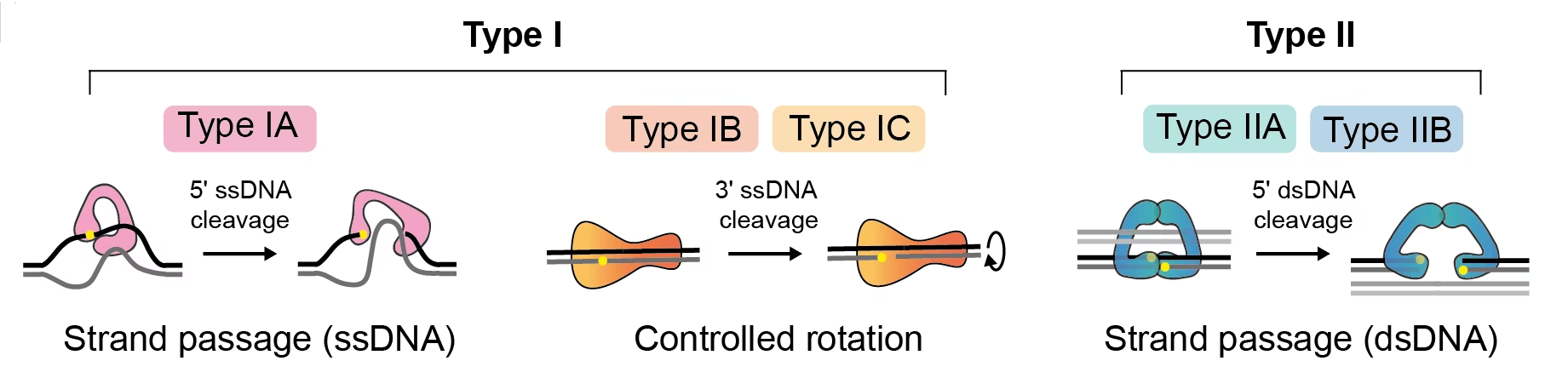
Figure 3. Summary of topoisomerase types and catalytic mechanisms. The topoisomerases are categorized based on whether they catalyze single- (type I) or double-stranded (type II) DNA breaks. The type I topoisomerases are further subdivided to type IA, IB and IC. Type IA form a transient covalent bond to the 5ʹ DNA phosphate and function via a strand passage mechanism. Type IB and IC form a transient covalent bond to the 3ʹ DNA phosphate and function via a controlled-rotation mechanism. Type II topoisomerases are further subdivided into type IIA and IIB. Both form a transient covalent bond to the 5ʹ DNA phosphate of both strands of the duplex and function via a strand-passage mechanism.