Sanakirja
Tekoälykääntäjä



Pertaining to a vowel.
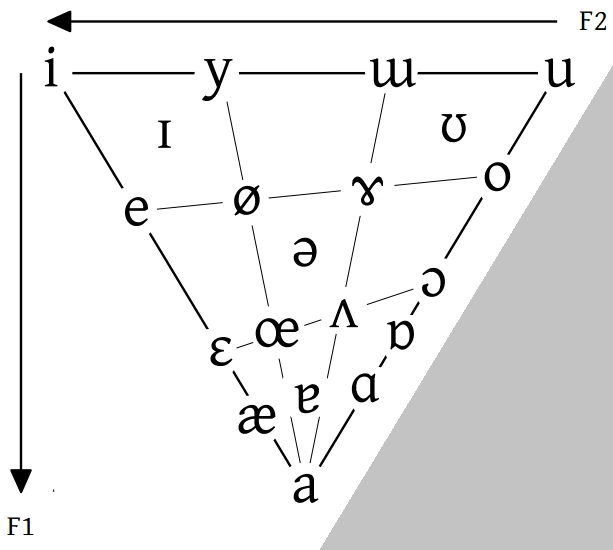

An idealized schematic of vowel space, based on the formants of Daniel Jones and John Wells pronouncing the cardinal vowels of the IPA. The scale is logarithmic. The grey range is where F2 would be less than F1, which by definition is impossible. [a] is an extra-low central vowel. Phonemically it may be front or back, depending on the language. Rounded vowels that are front in tongue position are front-central in formant space, while unrounded vowels that are back in articulation are back-central in formant space. Thus [yɯ] have perhaps similar F1 and F2 values to the high central vowels [ɨʉ], being distinguished by rounding (F3); similarly [øɤ] vs central [ɘɵ] and [œʌ] vs central [ɜɞ].

Pertaining to a vowel.
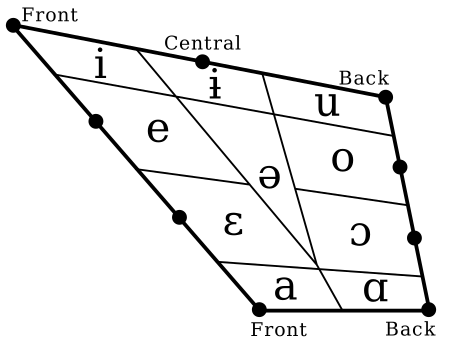
The original vowel quadrilateral, from Jones' articulation. The vowel trapezoid of the modern IPA, and at the top of this article, is a simplified rendition of this diagram. The bullets are the cardinal vowel points. (A parallel diagram covers the front and central rounded and back unrounded vowels.) The cells indicate the ranges of articulation that could reasonably be transcribed with those cardinal vowel letters, [i,e,ɛ,a,ɑ,ɔ,o,u,ɨ], and non-cardinal [ə]. If a language distinguishes fewer than these vowel qualities, [e,ɛ] could be merged to ⟨e⟩, [o,ɔ] to ⟨o⟩, [a,ɑ] to ⟨a⟩, etc. If a language distinguishes more, ⟨ɪ⟩ could be added where the ranges of [i,e,ɨ,ə] intersect, ⟨ʊ⟩ where [u,o,ɨ,ə] intersect, and ⟨ɐ⟩ where [ɛ,ɔ,a,ɑ,ə] intersect.