Sanakirja
Tekoälykääntäjä

Kuvat
4


| Kieli | Käännökset |
|---|---|
| espanja | sístole |
| hollanti | systole |
| italia | sistole, miocardia |
| portugali | sístole |
| ranska | systole |
| saksa | Systole |
| suomi | systole |
Määritelmät
Substantiivi
- (physiology) The rhythmic contraction of the heart, by which blood is driven through the arteries.
- (prosody) A shortening of a naturally long vowel.
- (mathematics) The shortest noncontractible loop on a compact metric space.
- (biology) The contraction of the contractile vesicles in certain algae, plasmodia, and zoospores.
Esimerkit
- A double systole catapulted him into full consciousness again, and he promised his uncorrected self that he would limit his daily ration of cigarettes to a couple of heartbeats.
- There is no essential virtue in comfort. To be relaxed is good if it is part of a process of systole and diastole. Relaxation comes between phases of tenseness.
Taivutusmuodot
| Monikko | systoles |
(physiology) The rhythmic contraction of the heart, by which blood is driven through the arteries.
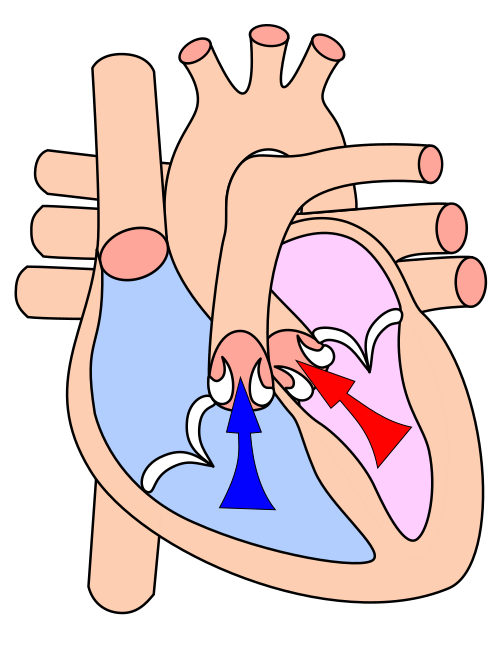
The cardiac cycle at the point of beginning a ventricular systole, or contraction: 1) newly oxygenated blood (red arrow) in the left ventricle begins pulsing through the aortic valve to supply all body systems; 2) oxygen-depleted blood (blue arrow) in the right ventricle begins pulsing through the pulmonic (pulmonary) valve en route to the lungs for reoxygenation.
(physiology) The rhythmic contraction of the heart, by which blood is driven through the arteries.
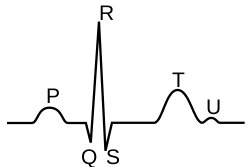
Electrical waves track a systole (a contraction) of the heart. The end-point of the P wave depolarization is the start-point of the atrial stage of systole. The ventricular stage of systole begins at the R peak of the QRS wave complex; the T wave indicates the end of ventricular contraction, after which ventricular relaxation (ventricular diastole) begins.
(physiology) The rhythmic contraction of the heart, by which blood is driven through the arteries.
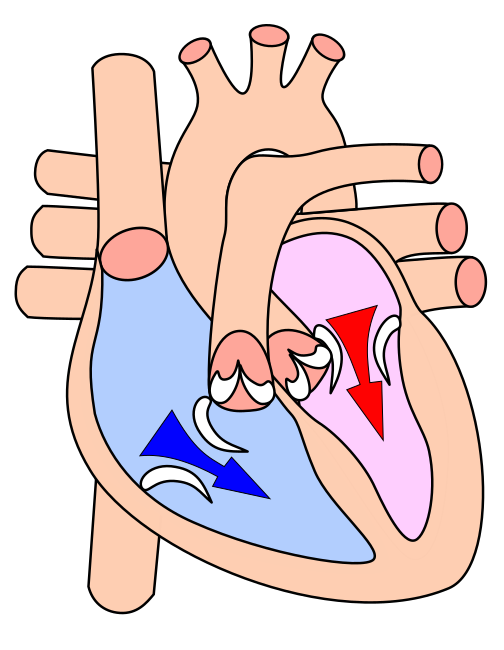
The cardiac cycle at beginning of atrial systole: The left (red) and right (blue) ventricles begin to fill during ventricular diastole. Then, after tracing the P wave of the ECG, the two atria begin contracting (systole), pulsing blood under pressure into the ventricles.