Sanakirja
Tekoälykääntäjä

Kuvat
16

Vaihtoehtoiset kirjoitusmuodot

| Kieli | Käännökset |
|---|---|
| espanja | anfetamina, anfetamínico |
| italia | anfetamina, amfetamina, simpamina, anfetaminica |
| japani | アンフェタミン (anfuェtamin / anfetamin) |
| kreikka | αμφεταμίνη (amfetamíni) |
| portugali | anfetamina |
| puola | ścierwo |
| ranska | amphétamine |
| ruotsi | amfetamin |
| saksa | Benzedrin, Amphetamin |
| suomi | amfetamiini |
| turkki | amfetamin |
| tšekki | amfetamin |
| unkari | amfetamin |
| venäjä | амфетами́н (amfetamín), амфетамин (amfetamin) |
| viro | amfetamiin |
Määritelmät
Substantiivi
- (organic chemistry, proper) The racemic freebase of 1-phenylpropan-2-amine; an equal parts mixture of levoamphetamine and dextroamphetamine in their pure amine forms.
- (informal) Any mixture of the two amphetamine enantiomers, dextroamphetamine and levoamphetamine.
- (informal, nonstandard) Referring to a substituted amphetamine; a member of the amphetamine class of chemicals.
- (medicine, pharmacology) A potent central nervous system stimulant of the phenethylamine chemical class that is used to treat ADHD, narcolepsy, and obesity.
Taivutusmuodot
| Monikko | amphetamines |
Luokat
(organic chemistry, proper) The racemic freebase of 1-phenylpropan-2-amine; an equal parts mixture of levoamphetamine and dextroamphetamine in their pure amine forms.

Levoamphetamine 3D-Ball and Stick Model
(informal) Any mixture of the two amphetamine enantiomers, dextroamphetamine and levoamphetamine.
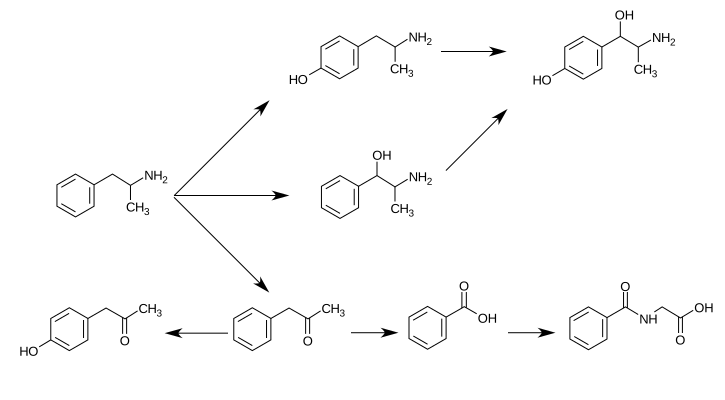
Metabolic pathways of amphetamine in humans – Amphetamine – 4-Hydroxyphenylacetone – Phenylacetone – Benzoic acid – Hippuric acid – Norephedrine – 4-Hydroxyamphetamine – 4-Hydroxynorephedrine – Para- Hydroxylation – Para- Hydroxylation – Para- Hydroxylation – CYP2D6 – CYP2D6 – Unidentified – Beta- Hydroxylation – Beta- Hydroxylation – Oxidative Deamination – FMO3 – Oxidation – Unidentified – Glycine Conjugation – XM-ligase – GLYAT – The primary active metabolites of amphetamine are 4-hydroxyamphetamine and norephedrine; at normal urine pH, about 30–40% of amphetamine is excreted unchanged and roughly 50% is excreted as the inactive metabolites (bottom row). The remaining 10–20% is excreted as the active metabolites. Benzoic acid is metabolized by butyrate-CoA ligase into an intermediate product, benzoyl-CoA, which is then metabolized by glycine N-acyltransferase into hippuric acid.
(informal, nonstandard) Referring to a substituted amphetamine; a member of the amphetamine class of chemicals.

Dextroamphetamine Ball and Stick Model
(medicine, pharmacology) A potent central nervous system stimulant of the phenethylamine chemical class that is used to treat ADHD, narcolepsy, and obesity.

Amphetamine enters the presynaptic neuron across the neuronal membrane or through dopamine transporter (DAT). Once inside, it binds to trace amine-associated receptor 1 (TAAR1) or enters synaptic vesicles through vesicular monoamine transporter 2 (VMAT2). When amphetamine enters synaptic vesicles through VMAT2, it collapses the vesicular pH gradient, which in turn causes dopamine to be released into the cytosol (light tan-colored area) through VMAT2. When amphetamine binds to TAAR1, it reduces the firing rate of the dopamine neuron via G protein-coupled inwardly rectifying potassium channels (GIRKs) and activates protein kinase A (PKA) and protein kinase C (PKC), which subsequently phosphorylate DAT. PKA phosphorylation causes DAT to withdraw into the presynaptic neuron (internalize) and cease transport. PKC-phosphorylated DAT may either operate in reverse or, like PKA-phosphorylated DAT, internalize and cease transport. Amphetamine is also known to increase intracellular calcium, an effect which is associated with DAT phosphorylation through a CAMKIIα-dependent pathway, in turn producing dopamine efflux.