Sanakirja
Tekoälykääntäjä


| Kieli | Käännökset |
|---|---|
| hollanti | ionische binding |
| italia | legame ionico |
| saksa | Ionenbindung |
| suomi | ionisidos |
| turkki | iyonik bağ |
Määritelmät
Substantiivi
- (physical chemistry) A type of chemical bond where two atoms or molecules are connected to each other by electrostatic attraction.
Taivutusmuodot
| Monikko | ionic bonds |
Luokat
(physical chemistry) A type of chemical bond where two atoms or molecules are connected to each other by electrostatic attraction.
Sodium and fluorine atoms undergoing a redox reaction to form sodium ions and fluoride ions. Sodium loses its outer electron to give it a stable electron configuration, and this electron enters the fluorine atom exothermically. The oppositely charged ions – typically a great many of them – are then attracted to each other to form solid sodium fluoride.
(physical chemistry) A type of chemical bond where two atoms or molecules are connected to each other by electrostatic attraction.
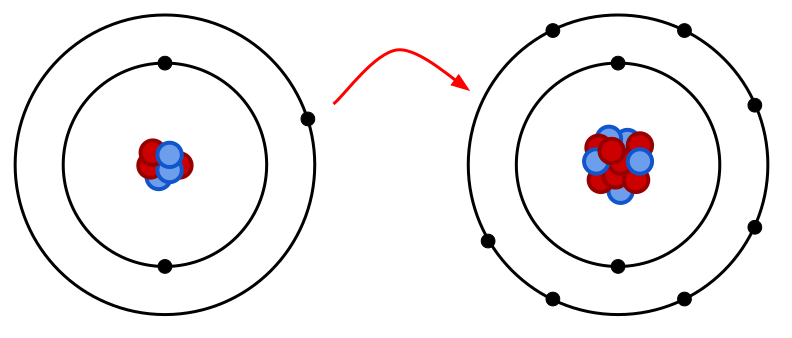
Representation of ionic bonding between lithium and fluorine to form lithium fluoride. Lithium has a low ionization energy and readily gives up its lone valence electron to a fluorine atom, which has a positive electron affinity and accepts the electron that was donated by the lithium atom. The end-result is that lithium is isoelectronic with helium and fluorine is isoelectronic with neon. Electrostatic interaction occurs between the two resulting ions, but typically aggregation is not limited to two of them. Instead, aggregation into a whole lattice held together by ionic bonding is the result.
(physical chemistry) A type of chemical bond where two atoms or molecules are connected to each other by electrostatic attraction.

In the rock salt lattice, each sodium ion (purple sphere) has an electrostatic interaction with its eight nearest-neighbour chloride ions (green spheres)