Sanakirja
Tekoälykääntäjä


Ääntäminen
 Southern England
- Tuntematon aksentti:
- IPA: /ˈproʊtɪst/
| Kieli | Käännökset |
|---|---|
| bulgaria | протист (protist) |
| espanja | protista |
| esperanto | protisto |
| hollanti | protist |
| italia | protista |
| japani | 原生生物 (gensei seibutsu / gensei-seibutsu), げんせいせいぶつ (genseiseibutsu) |
| portugali | protista |
| puola | protista |
| ranska | protiste |
| saksa | Protist |
| suomi | alkueliö, protoktisti, protisti |
| tanska | protist |
| turkki | protist |
| tšekki | protista |
| unkari | protiszta |
| venäjä | протист (protist) |
| viro | protist |
Määritelmät
Substantiivi
- (microbiology) Any of the eukaryotic, usually unicellular organisms—including protozoans, slime molds and some algae—historically grouped into the kingdom Protista (or Protoctista), now distributed over several clades; any eukaryote that is not a plant, animal or fungus.
- Any single-celled eukaryote, prokaryote or sponge .
- Any single-celled eukaryote or prokaryote .
- Any single-celled eukaryote .
Taivutusmuodot
| Monikko | protists |
Luokat
(microbiology) Any of the eukaryotic, usually unicellular organisms—including protozoans, slime molds and some algae—historically grouped into the kingdom Protista (or Protoctista), now distributed over several clades; any eukaryote that is not a plant, animal or fungus.

Examples of protists. Clockwise from top left: red algae, kelp, ciliate, golden alga, dinoflagellate, metamonad, amoeba, slime mold.
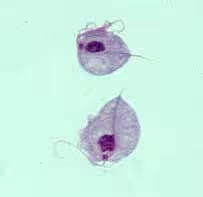
(microbiology) Any of the eukaryotic, usually unicellular organisms—including protozoans, slime molds and some algae—historically grouped into the kingdom Protista (or Protoctista), now distributed over several clades; any eukaryote that is not a plant, animal or fungus.

The tree of life showing the position of protists, from which all other eukaryotes evolved.