Sanakirja
Tekoälykääntäjä

Kuvat
3

Vaihtoehtoiset kirjoitusmuodot

| Kieli | Käännökset |
|---|---|
| espanja | semidiós |
| hollanti | halfgod |
| italia | semidio |
| japani | 半神 (hanshin) |
| kreikka | ήρωας (íroas), ημίθεος (imítheos) |
| latina | semideus, hērōs |
| liettua | pusdievis |
| portugali | semideus |
| puola | półbóg, bóstwo |
| ranska | demi-dieu |
| ruotsi | halvgud |
| saksa | Halbgott |
| suomi | puolijumala |
| tšekki | polobůh |
| unkari | félisten |
| venäjä | полубог (polubog), божество (božestvo) |
Määritelmät
Substantiivi
Taivutusmuodot
| Monikko | demigods |
| Feminiinimuoto | demigoddess |
Luokat
(mythology) A half-god or hero; the offspring of a deity and a mortal.
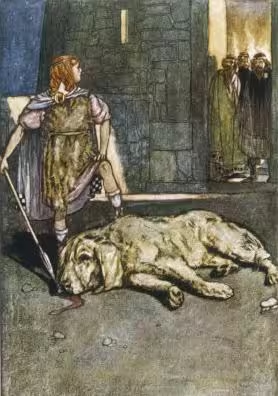
"Cuchulain Slays the Hound of Culain", illustration by Stephen Reid from Eleanor Hull's The Boys' Cuchulain, 1904
(mythology) A half-god or hero; the offspring of a deity and a mortal.

Väinämöinen, the central character in Finnish folklore and the main character in the national epic Kalevala by Elias Lönnrot, is an old and wise demigod, who possesses a potent, magical singing-voice. Picture of the Väinämöinen's Play by Robert Wilhelm Ekman, 1866
